





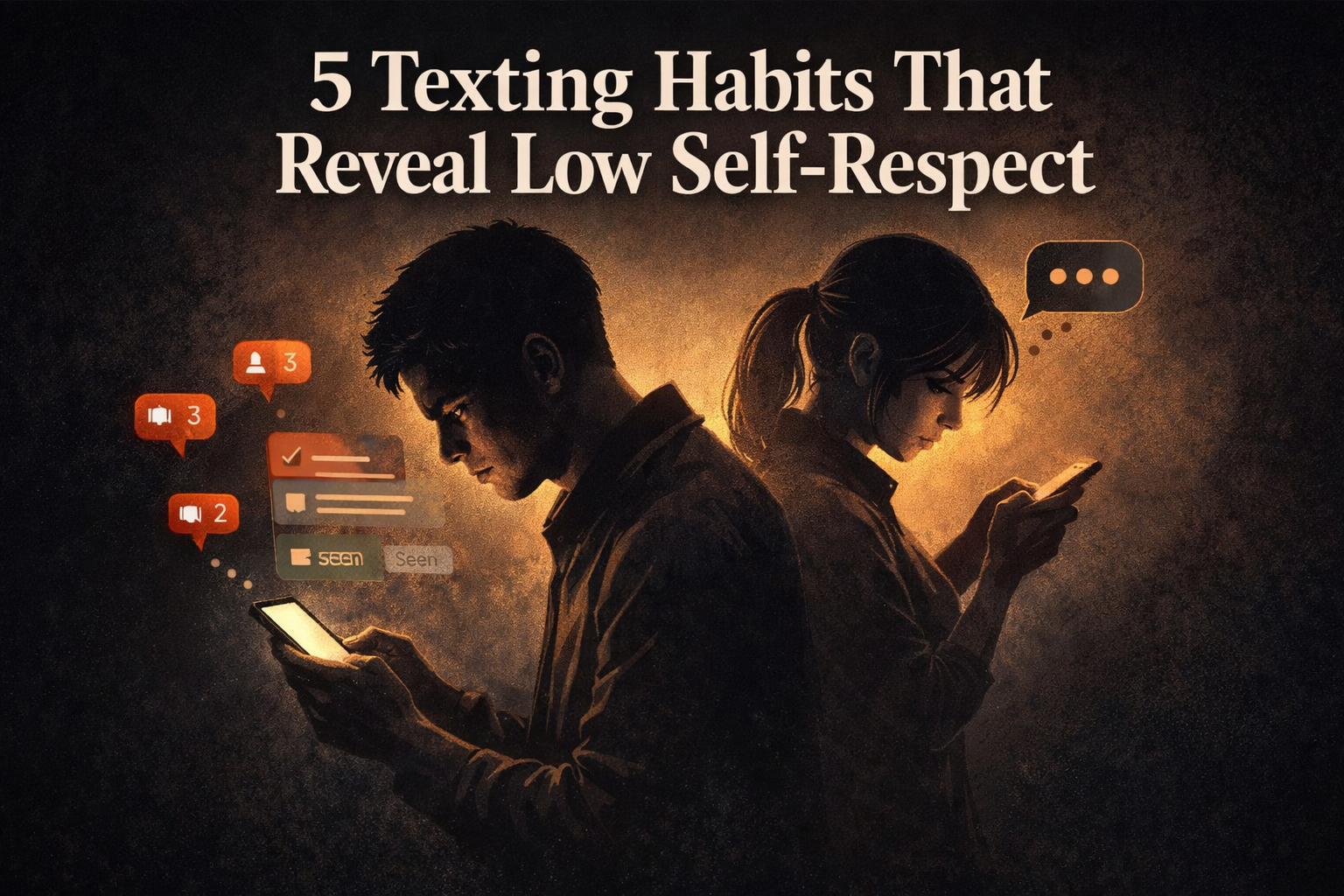
Texting is supposed to be simple. You type, you send, you move on with your day.
But for a lot of people, texting has turned into a mini emotional battlefield where confidence, boundaries, and self-worth quietly get tested in real time.
One message can feel like courage.
One seen tick can feel like rejection.
One late reply can trigger a full story in your head that you did not even ask to write.
And the most frustrating part is that many of the habits that damage your self-respect do not look “dramatic” on the surface. They look normal. They look friendly. They look polite. They look like effort.
But underneath, they often come from one uncomfortable place.
The fear of being ignored.
This blog is not written to shame anyone, because most of these habits are learned. They are often built in childhood, reinforced through bad relationships, and strengthened by the modern world where attention has become a currency. The goal here is to help you notice these patterns and replace them with something healthier, something stronger, and something that still feels like you.
You do not need to become rude, distant, or emotionally unavailable.
You simply need to stop begging for attention from people who would not even notice your absence.
Let’s break down five texting habits that often reveal low self-respect, why they happen, how they damage your energy, and what to do instead if you want to communicate like someone who values themselves.
1- Double Texting Without a Reply
“Hey?” “Hello?” “You there?” “Just checking…”
Double texting is not always wrong. If you forgot to add something important, or you are coordinating a plan, or you genuinely need an answer quickly, sending another message makes sense.
The problem begins when your second message is not about clarity, but about anxiety.
This is the version where you send a message, you wait, and then your mind starts behaving like a broken alarm system. You start thinking you said something wrong. You start assuming you got ignored. You start feeling that uncomfortable emptiness that makes you want to “fix” the silence by adding more words.
So you send a follow-up. Then another one.
And now, instead of being someone communicating, you feel like someone chasing.
That feeling is the real issue.
Because the moment you start double texting like this, you are doing something subtle but powerful.
You are telling the other person that their attention is more valuable than your dignity.
Even worse, you are training your own brain to believe that silence is a threat, and that your job is to fill it. That is not communication. That is emotional dependency disguised as conversation.
Why people do this
Double texting without a reply often comes from a mix of insecurity, fear of abandonment, and over-attachment. It is also common in people who have experienced inconsistent treatment in the past, where they were sometimes loved intensely and sometimes ignored completely.
Your nervous system gets used to unpredictability, and you start treating delayed replies like danger signals.
How it hurts you
It creates an imbalance. You become the “effort person” in every interaction.
It lowers your value in your own eyes.
It often makes the other person feel pressured, which can push them away, even if they liked you initially.
What to do instead
If you send a message, give it room to breathe.
A simple rule that helps:
If you are texting to connect, wait.
If you are texting to control the outcome, stop.
If the message was important, you can follow up once after a reasonable time, but do it with confidence and clarity instead of desperation. For example:
Instead of:
“Hey???”
“Why aren’t you replying?”
“Did I do something?”
Say:
“Hey, just checking if you saw this. No rush.”
This keeps your dignity intact while still being human.
And if someone repeatedly ignores you, the real answer is not more messages.
The real answer is less access.
2- Over-Apologizing for Small Things
“Sorry for texting.” “Sorry for bothering you.” “Sorry I’m like this.”
Some people apologize so much while texting that their messages start to sound like they are asking permission to exist.
They apologize for replying late.
They apologize for replying fast.
They apologize for asking a question.
They apologize for sending a long message.
They apologize for being emotional.
They apologize for not being emotional enough.
And after a while, it starts to create a weird dynamic, because the other person is not even treating you badly, but you are treating yourself like you are a burden.
This habit is one of the clearest signals of low self-respect because it turns normal communication into a confession of guilt.
You are not a criminal for texting someone.
You are not “too much” for expressing something.
You are not wrong for wanting clarity.
Why people do this
Over-apologizing usually comes from people-pleasing. It often comes from environments where you were made to feel that your needs were inconvenient, your emotions were dramatic, and your presence required you to stay “easy to handle.”
So you learned that the safest way to exist is to keep shrinking yourself, while constantly offering apologies as a peace treaty.
How it hurts you
It creates a weak identity in conversations.
It encourages the other person to see you as someone they can dominate.
It makes you feel guilty for normal human behaviour, which slowly kills your confidence.
Also, people do not respect someone who is constantly apologizing for existing, because it signals that even you do not believe you deserve space.
What to do instead
Replace unnecessary apologies with thank you statements.
Instead of:
“Sorry I’m late.”
Say:
“Thanks for waiting.”
Instead of:
“Sorry for the long message.”
Say:
“I wanted to explain it properly.”
Instead of:
“Sorry I’m being annoying.”
Say:
“I needed to share this.”
This shifts your energy from guilt to ownership, and ownership always looks stronger.
There is a massive difference between being respectful and being self-erasing.
Respectful people communicate with kindness.
Self-erasing people communicate with fear.
Choose kindness, not fear.
3- Sending Emotional Messages That Expect Reassurance
“Are you upset with me?” “Do you still like me?” “Tell me you’re not leaving.”
This is one of the most common texting patterns in modern relationships, and it is also one of the most exhausting ones, because it turns the other person into your emotional regulator.
Sometimes, people send emotional messages not because they want to express a feeling, but because they want the other person to rescue them from that feeling.
They want reassurance, not connection.
They want security, not understanding.
They want confirmation, not communication.
So they send messages like:
“You seem distant today.”
“I feel like you don’t care.”
“Did I do something wrong?”
“I guess I’m not important.”
Now, if someone truly is being disrespectful, bringing it up is fair.
But if the message comes from your own insecurity rather than their behaviour, it becomes a trap.
Because you are not asking for truth, you are asking for comfort.
And comfort is temporary. It fades.
Then you need it again.
And again.
And again.
That cycle never ends until you build inner stability.
Why people do this
This habit often comes from emotional neglect, inconsistent relationships, and low self-confidence. It happens when you do not fully trust your own worth, so you treat someone else’s attention like proof that you matter.
Also, social media and modern dating made this worse, because everyone is “available” but also always distracted, so people start feeling replaceable.
How it hurts you
It makes your mood dependent on someone else’s replies.
It creates emotional fatigue in the relationship.
It makes you vulnerable to manipulation, because people who love control will use your insecurity against you.
What to do instead
There is nothing wrong with expressing emotions, but there is a difference between expressing and dumping.
Try this shift:
Instead of:
“Are you angry at me? You’re not replying.”
Say:
“Hey, I feel a bit uneasy when communication feels unclear. Just checking if everything is okay.”
That sentence shows maturity because you are owning your feeling while still leaving space for reality.
And beyond messaging, do the deeper work: learn to self-soothe.
Before sending an insecurity-driven text, pause and ask:
Am I reacting to facts or fear?
If it is fear, take ten minutes and regulate first. Walk, breathe, distract, journal, do anything that brings you back into balance. Then decide whether the message still needs to be sent.
Self-respect grows when you stop outsourcing your emotional stability.
4 – Always Replying Immediately Even When You’re Busy
“I was in a meeting but I still replied.” “I replied from the bathroom.” “I replied while driving.”
Fast replies are not a weakness by default. Some people are quick because they are responsive, attentive, and naturally efficient.
But the habit becomes unhealthy when you are replying fast not because you want to, but because you fear what happens if you don’t.
Many people reply instantly even when they are busy because they think delay equals disrespect. Or they think that if they do not respond quickly, the other person will lose interest. Or worse, they believe their worth depends on being always available.
This is not love.
This is auditioning for approval.
And the worst part is that it often makes you invisible in your own life. You start living around other people’s notifications instead of your own priorities.
Why people do this
It often comes from people who associate responsiveness with being liked, needed, or chosen. They believe being available makes them valuable.
This is especially common in relationships where the other person gives attention inconsistently, because your brain starts treating fast replies as a strategy to “keep” them.
How it hurts you
It weakens your boundaries.
It tells people that your time is always flexible, which means they never need to respect it.
It creates burnout and distraction.
It reduces your focus and self-control.
It also creates a long-term imbalance where the other person gets used to you being instantly available, and then when you act normal, they act offended.
What to do instead
Respond with intention, not anxiety.
If you are busy, you can reply like a person who has a life, because you do.
For example:
“Hey, I’m tied up right now. I’ll reply properly when I’m free.”
That sentence is not rude. It is healthy.
Your time deserves protection. Your attention deserves ownership.
If someone gets angry because you didn’t reply instantly, that is not your responsibility to fix. It is their entitlement showing itself.
5- Constantly Checking If Your Text Was Read Or Replied To
“Seen” becomes your daily stress report.
This habit is the silent killer, because it seems harmless. You are not sending extra messages. You are not saying anything wrong. You are just checking.
But the emotional damage happens inside you.
You check once. Then again.
Then you check after five minutes.
Then you check after ten minutes.
Then you start calculating how long it usually takes them to reply.
Then you start replaying your message.
Then you start editing your self-worth based on their response time.
This is not about texting anymore.
This is about self-respect leaking away drop by drop.
Because when you constantly check read receipts or last-seen status, you are telling yourself that your peace is dependent on a notification.
And that is an exhausting way to live.
Why people do this
It comes from anxiety, insecurity, and over-attachment. It also comes from relationships where attention and affection were used as control tools, so you learned to track behaviour like a detective.
This habit also increases when you have too much unstructured time, because your mind fills the empty space with obsession.
How it hurts you
It turns you into a prisoner of expectation.
It creates constant emotional tension.
It reduces productivity and mental clarity.
It makes you interpret everything personally.
Even when the other person is simply busy.
What to do instead
Train yourself to send and release.
One of the most powerful habits for self-respect is learning to tolerate uncertainty without collapsing.
After sending a message, shift your focus. Do something physical or meaningful. Work, gym, reading, cooking, music, journaling, anything that anchors you in your life.
Also, if read receipts trigger you, turn them off.
Some people treat that as “hiding,” but it is not hiding. It is protecting your peace.
The point of texting is communication, not emotional surveillance.
If someone values you, you will feel it without needing to monitor it.
The Real Issue Behind These Habits: You’re Trying to Earn What You Deserve
Most low self-respect texting habits come from the same emotional root.
You feel like love, attention, or importance must be earned.
So you try to earn it by being available.
You try to earn it by being apologetic.
You try to earn it by being extra sweet.
You try to earn it by being low-maintenance.
You try to earn it by being patient even when you are hurting.
But the hard truth is this.
The right people do not need you to perform your worth.
They simply respond.
They simply show up.
They simply care.
Self-respect is not about being cold. It is about being stable.
It is about not abandoning yourself just to keep someone else close.
How to Text Like Someone With Self-Respect (Without Becoming Emotionless)
You do not need to transform into a robot or start playing power games.
You simply need to communicate in a way that honours your time, your emotions, and your boundaries.
A self-respecting text style looks like this:
You say what you mean.
You stop over-explaining.
You stop trying to predict reactions.
You do not chase replies.
You do not beg for reassurance.
You respond when you are available, not when you are anxious.
You detach from outcomes you cannot control.
And most importantly, you accept one truth:
If someone wants to be in your life, they will not make you feel like a burden for existing in it.
A Simple 7-Day Reset Plan to Break These Habits
You do not need to fix everything overnight. You just need to build awareness and discipline.
Day 1: Stop sending follow-ups for non-urgent messages.
Day 2: Replace one “sorry” with a confident alternative.
Day 3: Do not text when you feel anxious. Wait ten minutes first.
Day 4: Reply when you are free, not immediately.
Day 5: Stop checking read receipts. Trust your life more than the screen.
Day 6: Communicate your boundary once, without guilt.
Day 7: Observe how people respond when you stop over-giving.
You will learn something very valuable during this reset.
Some people stay.
Some people get confused.
Some people disappear.
And that outcome is not a tragedy.
It is clarity.
Closing Thought: Self-Respect Is Not Loud, It Is Consistent
The biggest misunderstanding people have about confidence is that it needs to be aggressive. It does not.
Real self-respect is not about “winning” conversations or acting unbothered.
It is about having standards.
It is about choosing peace over panic.
It is about treating your attention like something valuable.
It is about knowing that you do not need to chase what is meant for you.
Texting habits are small actions, but they reveal big beliefs.
And once you start changing those habits, you are not just improving your communication.
You are rebuilding your relationship with yourself.
Because the most important person you should never abandon in any conversation is you.