
Most people grow up believing happiness is something you earn after you “fix” everything.
Fix your habits. Fix your career. Fix your relationships. Fix your body. Fix your bank balance. Fix your mindset. Fix your future. Fix your past.
And if you do not feel at peace, the world quickly gives you one simple explanation: you are not trying hard enough.
But life does not work like a checklist.
Life works like weather. It changes. It surprises you. It doesn’t care about your plans. It doesn’t wait until you feel ready. And it definitely does not ask you before it brings something messy, something emotional, something frustrating, or something painful into your day.
That is why contentment is not a soft concept for people who have “nothing to worry about.”
Contentment is a skill. A discipline. A form of emotional intelligence that stops you from bleeding energy into situations you cannot control.
When you learn to live with imperfections, you do not become careless or lazy.
You become stable.
And stability is underrated in a world that rewards drama, chaos, and performance.
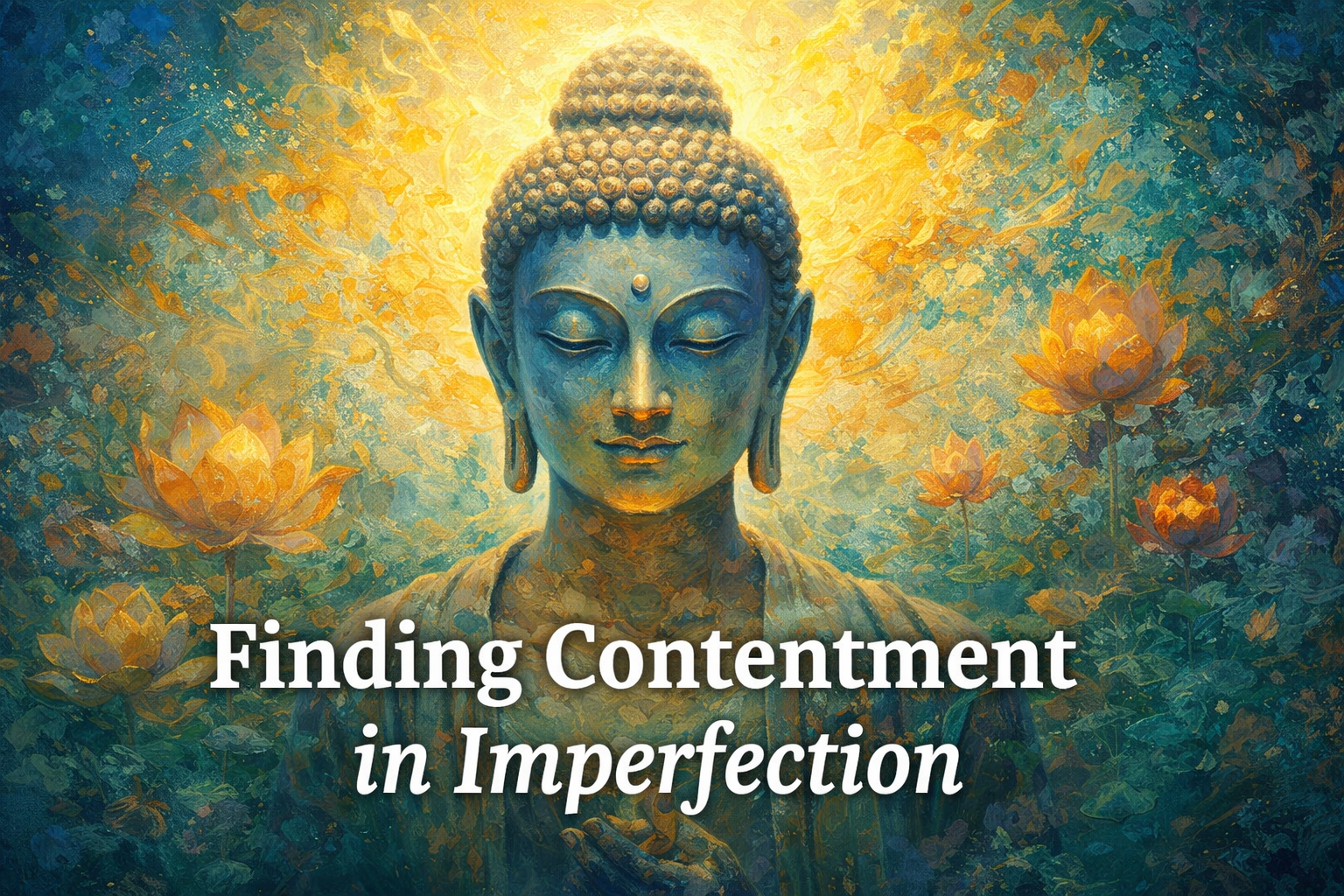
Contentment is what happens when you stop demanding that life behave perfectly before you allow yourself to breathe.
It is what happens when you stop measuring your peace based on how people treat you, how smooth your days are, or how ideal your circumstances look from the outside.
It is what happens when you stop negotiating with reality, and you start living inside it.
That does not mean you stop improving.
It means you stop punishing yourself while you improve.
Why People Struggle to Accept Imperfect Lives
The hardest part about contentment is not the concept itself.
The hardest part is unlearning the expectations that keep you anxious and disappointed.
Most people are not unhappy because life is terrible.
They are unhappy because life is not matching the picture they were sold.
They expected relationships to feel consistently warm, safe, validating, and predictable.
They expected love to be stable, communication to be easy, loyalty to be guaranteed, and emotional support to be available on demand.
They expected their careers to move in a straight line.
They expected effort to always lead to reward.
They expected hard work to get noticed.
They expected smart choices to prevent setbacks.
They expected their own minds to behave like obedient machines.
They expected confidence to be permanent, motivation to be reliable, and discipline to feel effortless after a certain point.
And when none of that happens, the mind does what it always does.
It starts accusing you.
It tells you something is wrong with you.
It tells you that you are behind.
It tells you that you are failing.
It tells you that other people have it better, and you are the only one struggling like this.
That is the real trap.
Not the imperfection, but the belief that imperfection is proof of failure.
If you treat every flaw as a problem that must be fixed immediately, you never get to rest.
You never get to enjoy your life while you are building it.
You never get to feel proud of yourself while you are evolving.
You stay in a permanent state of “almost.”
Almost happy. Almost settled. Almost okay.
Contentment begins when you stop waiting for perfection to allow peace into your life.
Warmth and Coldness in Human Relationships Are Normal
One of the most painful things people deal with is emotional inconsistency in relationships.
Someone who once felt close starts feeling distant.
Someone who used to care deeply becomes distracted.
Someone who made you feel important suddenly treats you like you are optional.
And in those moments, the mind becomes desperate for clarity.
You try to decode every text.
You replay every conversation.
You look for signs.
You read between lines that may not even exist.
Because humans hate uncertainty.
We want relationships to come with a clean label.
This person loves me.
This person is loyal.
This person will stay.
This person is safe.
But people are not static.
People do not wake up with the same emotional capacity every day.
Some days they are full of warmth.
Some days they are cold without even meaning to be.
Sometimes they are tired, stressed, overwhelmed, emotionally unavailable, or trapped in their own mental noise.
Sometimes they are not mature enough to communicate their shifts.
Sometimes they have unhealed patterns that make closeness feel threatening.
Sometimes they simply do not value the relationship as much as you do.
That is the uncomfortable truth.
Relationships are not guaranteed to stay in the same emotional temperature forever.
Even strong relationships go through seasons where the connection feels less alive.
Contentment does not mean you tolerate disrespect.
Contentment does not mean you accept emotional neglect as your normal.
Contentment does not mean you stay where you feel unwanted.
Contentment means you stop interpreting every cold moment as a personal disaster.
It means you stop using someone else’s mood as proof of your worth.
It means you stop begging for warmth from people who do not know how to hold it consistently.
And it means you learn how to offer yourself stability, even when another person is inconsistent.
That is not coldness.
That is self-respect.
The Painful Lesson of Impermanence
If there is one truth that humbles every human being, it is this.
Everything changes.
People change.
Feelings change.
Priorities change.
Bodies change.
Plans change.
Your social circle changes.
Your confidence changes.
Your energy changes.
Your life changes in ways you could not predict.
Impermanence is not punishment.
It is the design of life.
The problem is not change itself.
The problem is attachment to the idea that things should stay the same.
We love predictability because it makes us feel safe.
We love familiarity because it makes us feel in control.
But control is an illusion we hold tightly until life reminds us how fragile it is.
The hardest heartbreaks are not always romantic.
Sometimes the heartbreak is realizing that the version of life you were building will not happen the way you imagined.
Sometimes the heartbreak is losing someone who is still alive, but no longer present.
Sometimes the heartbreak is your own identity shifting, leaving you unsure of who you are becoming.
Impermanence is not just about losing people.
It is about losing expectations.
And here is where contentment becomes powerful.
Contentment means you can love deeply without demanding permanence as proof of value.
It means you can appreciate moments without trying to trap them.
Because the moment you accept that life moves, you stop living in fear of change.
You start living with awareness.
You start understanding that you are not here to control everything.
You are here to experience, to grow, and to find meaning even when reality does not match your plan.
Existence Is Not a Problem to Solve
A lot of people treat life like a constant project.
They wake up and immediately feel pressure to improve something.
Improve income.
Improve productivity.
Improve appearance.
Improve relationships.
Improve habits.
Improve mind.
And improvement is good, but the obsession with fixing yourself becomes toxic when you forget one simple thing.
You are allowed to exist even when you are not performing.
Existence is not an exam.
You are not here to prove that you deserve peace.
The reason so many people feel restless is because they treat their own lives like a business contract.
If they do enough, then they can finally feel proud.
If they succeed enough, then they can finally feel relaxed.
If they become perfect enough, then they can finally feel loved.
But contentment starts when you stop turning your life into a transaction.
You stop asking, “What do I need to achieve before I can feel okay?”
And you start asking, “What kind of person do I want to be while I live this life?”
That shift changes everything.
Because it moves you from chasing outcomes to building a grounded inner world.
Spiritual Practice Is Not Escaping Life, It Is Meeting It Properly
Many people misunderstand spiritual practice.
They think it means becoming detached, emotionless, or overly calm.
They imagine someone sitting above human struggles, untouched by pain, untouched by anger, untouched by fear.
That is not the real point.
The real point of spiritual practice is learning how to be human without being destroyed by your emotions.
It is learning how to observe your thoughts without treating them as commands.
It is learning how to sit with discomfort without panicking.
It is learning how to experience pain without turning it into identity.
Spiritual practice can be prayer, meditation, journaling, service, reading, reflection, gratitude, or solitude.
It is less about the method and more about the muscle you build.
The muscle of awareness.
When you develop awareness, you stop being controlled by every mood.
You stop chasing every impulse.
You stop reacting to every trigger like your life depends on it.
You create a small space between you and the chaos around you.
And in that space, you become powerful.
Contentment grows in that space because it gives you something most people never develop.
Emotional stability.
That stability becomes your inner anchor when relationships feel unpredictable, when life feels uncertain, and when your own mind tries to drag you into fear.
Contentment Is Not Settling, It Is Choosing Peace Without Lowering Your Standards
Some people hear the word “contentment” and think it means settling for less.
They think it means accepting a mediocre life.
But contentment is not giving up.
Contentment is refusing to suffer unnecessarily.
It is possible to want more and still feel grateful.
It is possible to build bigger dreams and still be present.
It is possible to be ambitious without being emotionally hungry.
Discontent is not the same as ambition.
Discontent is a state where your mind refuses to appreciate anything you have, because it is addicted to what you do not have.
Ambition is action-driven.
Discontent is anxiety-driven.
Contentment means you stop punishing today just because tomorrow is not here yet.
And that makes you more productive, not less.
Because you stop wasting energy on mental noise.
When you are content, you work from clarity.
You work from self-respect.
You work from grounded focus.
Not from insecurity.
How to Settle the Mind and Body Into Contentment
Contentment is not a magical switch.
It is something you create through consistent habits, mental discipline, and emotional honesty.
Here are the real ways it happens in daily life, not in theory.
1) Stop Fighting Reality as a Daily Habit
A lot of suffering comes from arguing with what is already happening.
You may not say it out loud, but inside your mind you are constantly resisting.
This should not be happening.
They should not be acting like this.
I should be further ahead.
I should not feel like this.
Life should be easier by now.
That inner argument drains you.
When you stop fighting reality, you stop bleeding energy.
That does not mean you approve of everything.
It means you accept the current moment as the starting point.
Because nothing changes from denial.
Acceptance is not surrender.
Acceptance is the decision to deal with life as it is, not as you wish it was.
2) Become Someone Who Self-Regulates, Not Someone Who Reacts
The difference between a stable person and an unstable person is not luck.
It is self-regulation.
Self-regulation means your emotional state is not at the mercy of external chaos.
It means you can feel anger without exploding.
It means you can feel sadness without collapsing.
It means you can feel disappointment without falling into bitterness.
Most people think emotional maturity is about never feeling negative emotions.
But emotional maturity is about not letting those emotions drive your behavior.
When you learn self-regulation, contentment becomes natural.
Because your nervous system is no longer living in emergency mode.
You start making choices from clarity, not from emotional pressure.
3) Stop Seeking Constant Validation Through People
This one is personal for many people, because relationships and approval feel like oxygen.
But the moment your peace depends on how others treat you, you become emotionally fragile.
Because other people are unpredictable.
Someone might love you deeply and still disappoint you.
Someone might respect you and still misunderstand you.
Someone might care for you and still leave.
If your self-worth depends on external validation, impermanence will break you again and again.
Contentment grows when you start validating yourself.
You start trusting your own judgment.
You start respecting your own boundaries.
You start living by your own values instead of chasing other people’s moods.
4) Treat Your Mind Like a Place You Live, Not a Place You Visit
You spend more time inside your mind than anywhere else.
So if your mind is constantly hostile, judgmental, and anxious, your life will feel heavy even when everything is fine.
Contentment grows when you change the tone of your inner voice.
Not by lying to yourself with fake positivity, but by speaking to yourself like a mature, supportive adult.
Instead of: “I always mess things up.”
You shift to: “This was a mistake, and I can fix it.”
Instead of: “Nobody cares.”
You shift to: “I feel alone right now, and I need to take care of myself.”
Instead of: “I am behind.”
You shift to: “I am still moving, and progress is not linear.”
That voice matters.
Because the way you speak to yourself becomes the atmosphere you live in.
5) Learn the Skill of Emotional Detachment Without Emotional Coldness
Emotional detachment does not mean you stop caring.
It means you stop collapsing when things do not go your way.
You stop tying your peace to outcomes.
You stop tying your identity to one person.
You stop tying your self-worth to one achievement.
You still love.
You still try.
You still give effort.
But you stop making your entire life dependent on one thing working out perfectly.
This is a powerful form of contentment because it gives you freedom.
Freedom to feel without being controlled.
Freedom to love without fear.
Freedom to lose without losing yourself.
The Real Power of Living With Imperfection
When you accept that life will always contain flaws, you stop being shocked by them.
You stop acting like a single setback ruins your future.
You stop acting like a bad day means a bad life.
You stop treating one rejection as proof you are not enough.
You become steady.
And that steadiness becomes a kind of power that cannot be bought or borrowed.
Because you stop being desperate.
You stop chasing people who are inconsistent.
You stop forcing connections that no longer fit.
You stop negotiating your boundaries to keep someone comfortable.
You stop trying to win love through sacrifice.
You start living with dignity.
And the strange thing is, contentment makes you more attractive to life.
Not because you become perfect, but because you become peaceful.
People trust someone who is emotionally stable.
Opportunities flow easier when you are not trapped in panic.
Relationships become healthier when you stop needing them to save you.
Contentment does not make life flawless.
It makes life lighter.
Finding Your Own Way Without Losing Yourself
At some point in life, everyone reaches a phase where the old formulas stop working.
People you trusted may disappoint you.
Plans you were sure about may collapse.
Your identity may shift.
Your confidence may take hits.
And that is when you realize something important.
You cannot outsource your peace.
Nobody can give you permanent security.
Nobody can guarantee they will always be warm.
Nobody can promise the future will be stable.
So you build your own way.
Your own way means you stop copying the emotional patterns of the world around you.
It means you stop living like your value depends on external approval.
It means you stop living like peace is something you earn at the end of a perfect life.
Instead, you learn to create peace inside an imperfect one.
You still care about growth.
You still care about love.
You still care about meaning.
You still care about becoming better.
But you stop destroying yourself in the process.
Contentment is not the absence of ambition.
It is the presence of inner stability.
And when your mind is settled, your body follows.
Your heart feels less heavy.
Your reactions soften.
Your decisions become clearer.
Your days become more livable.
Life does not become perfect.
But your relationship with life becomes stronger.
That is what real contentment looks like.
Not a life without problems.
A life where problems do not steal your power.