






How a 20 Minute Midday Reset Can Transform Your Focus, Mood, Productivity, and Mental Clarity
There is a strange contradiction in modern work culture that rarely gets questioned with any seriousness, even though its consequences show up every single day in the form of fatigue, poor decisions, irritability, and declining productivity across teams and individuals. People are expected to perform cognitively demanding tasks for eight to ten hours continuously while running on suboptimal sleep, overstimulated nervous systems, and back to back commitments that leave no space for mental recovery, and when energy begins to drop somewhere in the middle of the day, the immediate solution becomes another cup of coffee rather than a moment of genuine restoration.
Despite how normalized this has become, the human brain was never designed to operate at peak performance from morning to evening without some form of structured rest, and one of the simplest, most accessible, and surprisingly effective methods of restoring mental sharpness during the day is something that has been misunderstood for decades, dismissed as laziness by some, romanticized by others, and yet consistently supported by neuroscience and behavioral research across different environments and performance contexts.
That method is the power nap.
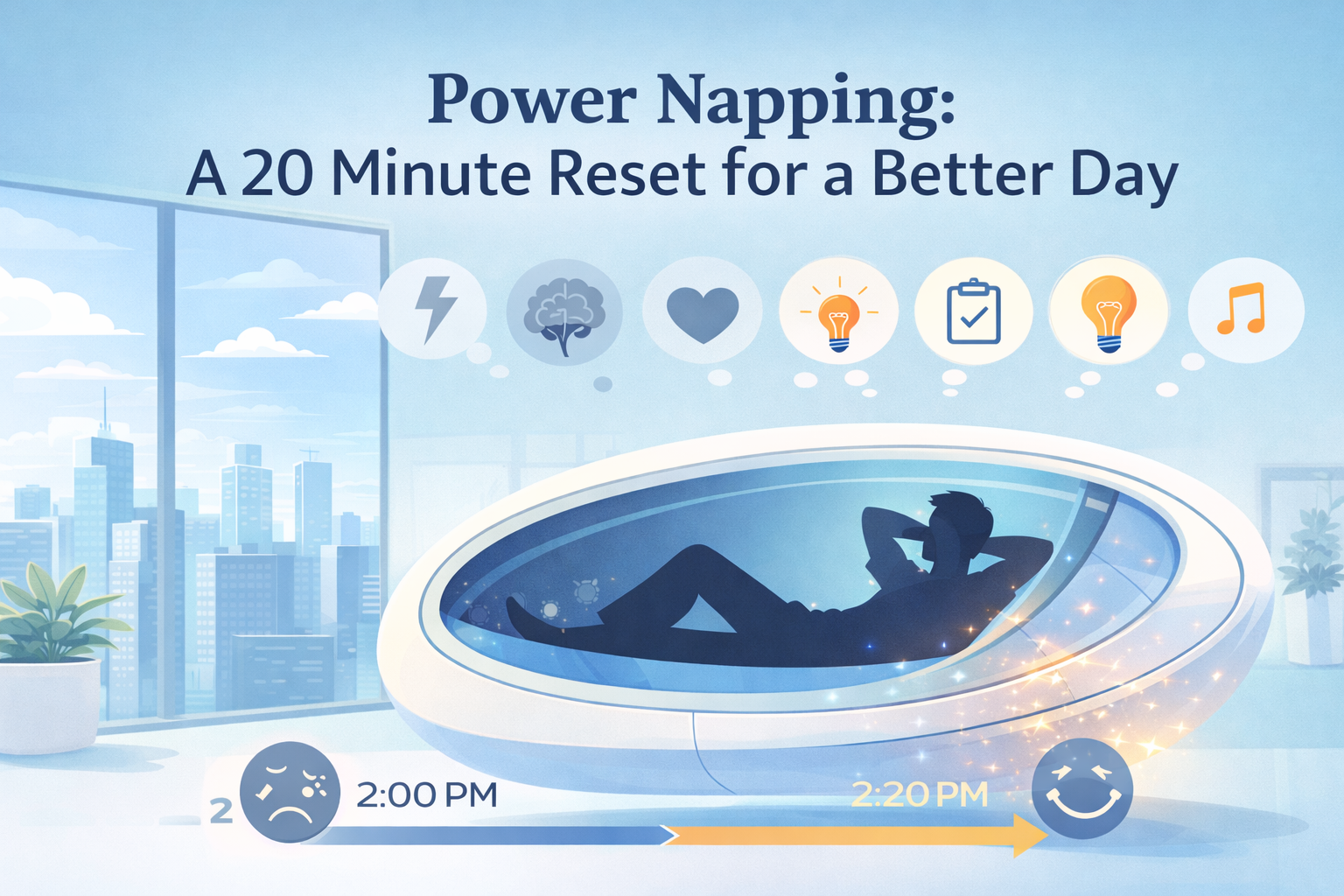
A power nap is not an extended afternoon sleep session that disrupts your nightly rest cycle or throws off your circadian rhythm in unpredictable ways, but rather a short and deliberate pause lasting somewhere between ten to twenty minutes that allows the brain to disengage from continuous sensory input, reduce mental fatigue, recalibrate neurotransmitter balance, and restore attentional control in a way that caffeine and willpower simply cannot replicate.
When used intelligently and timed correctly, power napping becomes less of a comfort activity and more of a performance strategy that enhances focus, emotional regulation, learning capacity, decision making, creativity, and overall cognitive efficiency without requiring any expensive tools, complex training, or major lifestyle adjustments.
Understanding why this works requires looking beyond surface level tiredness and examining what actually happens inside the brain during prolonged wakefulness and what changes when a brief period of sleep interrupts that cycle.
The Afternoon Cognitive Dip Is Biological, Not Psychological
Most people experience a noticeable drop in alertness during the early to mid afternoon period, often somewhere between one and three o’clock, and this decline in mental energy is frequently interpreted as laziness, lack of discipline, or insufficient motivation when in reality it reflects a natural circadian rhythm pattern that exists regardless of how committed or hardworking someone might be.
Body temperature decreases slightly during this phase, alertness signals weaken, reaction time slows, and the brain begins accumulating sleep pressure through the buildup of a chemical compound called adenosine that increases the longer you remain awake.
Adenosine plays a crucial role in promoting sleepiness, and its accumulation affects your ability to concentrate, sustain attention, process information efficiently, and maintain emotional stability when faced with even minor inconveniences or interruptions.
As adenosine levels rise, your prefrontal cortex, which governs decision making, impulse control, working memory, and logical reasoning, becomes less effective in regulating both cognitive processes and emotional responses.
You may still appear functional on the outside, responding to emails, attending meetings, participating in discussions, yet internally your ability to filter distractions, manage complex information, and respond thoughtfully begins to erode gradually, often without immediate awareness.
This is why people find themselves rereading the same paragraph repeatedly without absorbing its meaning, forgetting tasks they had planned just moments earlier, or reacting more sharply than usual to routine workplace frustrations.
A power nap interrupts this process by allowing the brain to temporarily disengage from sensory processing and reduce adenosine concentration, thereby restoring some degree of neural efficiency and attentional control without requiring a full sleep cycle.
Restorative Energy Without Artificial Stimulation
The traditional response to midday fatigue often involves caffeine consumption, which blocks adenosine receptors in the brain and creates the temporary illusion of alertness without addressing the underlying chemical accumulation that caused tiredness in the first place.
While caffeine can be useful in certain contexts, relying on it repeatedly throughout the day may lead to overstimulation, increased heart rate, digestive discomfort, sleep disruption later in the evening, and an eventual crash once its effects wear off.
A short nap operates through a fundamentally different mechanism by reducing adenosine naturally rather than blocking its effects, allowing energy levels to stabilize rather than spike and drop unpredictably.
This leads to a form of alertness that feels grounded instead of jittery, where mental clarity returns without the restlessness or racing thoughts often associated with stimulant use.
Many individuals who incorporate short naps into their routine report that their afternoon productivity improves without requiring additional caffeine intake, which in turn supports better nighttime sleep quality and reduces the likelihood of entering a cycle of dependency on stimulants to maintain baseline performance.
Working with biological rhythms instead of suppressing them allows for sustainable energy management that does not compromise long term health or cognitive stability.
Memory Consolidation and Learning Efficiency
Learning new information is not limited to the time spent actively engaging with material, because the brain requires additional processing periods to organize, store, and integrate that information into existing neural networks.
Without sufficient rest, newly acquired knowledge remains fragile and more susceptible to decay, making it difficult to recall or apply later in practical scenarios.
During even brief periods of sleep, the brain engages in a process known as memory consolidation, where recently formed neural connections are strengthened, reorganized, and linked with prior knowledge structures.
This process improves both recall accuracy and conceptual understanding, enabling individuals to retrieve information more effectively when needed.
Students preparing for examinations, professionals learning new systems or methodologies, and anyone attempting to acquire complex skills can benefit from this effect by scheduling short naps after intensive study or training sessions.
Returning to the material after a brief rest often reveals that previously confusing concepts feel clearer, relationships between ideas become more apparent, and retention improves without additional effort.
In knowledge driven environments where continuous learning forms the basis of performance and career advancement, even marginal gains in retention and comprehension can accumulate significantly over time.
Emotional Regulation and Interpersonal Stability
Fatigue affects not only cognitive performance but also emotional resilience, increasing sensitivity to stressors that might otherwise feel manageable under well rested conditions.
When sleep deprived, the amygdala, which processes emotional reactions, becomes more reactive, while regulatory input from the prefrontal cortex weakens, leading to heightened responses to perceived challenges or frustrations.
This imbalance can result in irritability, impatience, and difficulty maintaining composure during interactions that require diplomacy or collaborative problem solving.
A short nap helps restore some degree of balance between emotional reactivity and rational control by allowing the brain to reset neural activity patterns associated with stress response.
After resting, individuals often report improved patience, greater tolerance for ambiguity, and an increased capacity to respond thoughtfully rather than react impulsively.
In professional settings where teamwork, leadership, and communication play central roles in achieving outcomes, emotional regulation contributes directly to both efficiency and workplace harmony.
Small conflicts that might escalate unnecessarily during periods of fatigue become easier to navigate when cognitive resources are replenished.
Stress Reduction Through Nervous System Regulation
Continuous mental engagement without adequate rest maintains the sympathetic nervous system in a heightened state of activation, which may contribute to sustained increases in heart rate, muscle tension, and cortisol release.
This physiological state prepares the body for immediate action but becomes counterproductive when maintained for extended periods in environments that demand strategic thinking rather than physical response.
Power napping facilitates a shift toward parasympathetic activation, allowing the body to enter a restorative mode characterized by reduced heart rate, lower stress hormone levels, and improved metabolic balance.
This shift promotes mental calmness and reduces the likelihood of cognitive overload, making it easier to approach complex tasks with clarity rather than anxiety.
In high pressure roles that require constant decision making, the ability to reset stress levels during the day can prevent burnout and maintain consistent performance across extended work cycles.
Improved Accuracy and Reduced Error Rates
Fatigue increases the likelihood of mistakes by impairing attention, slowing reaction times, and reducing the brain’s capacity to detect inconsistencies or anomalies within data streams or operational workflows.
Even minor errors can accumulate quickly in environments where precision matters, leading to inefficiencies, rework, and sometimes costly consequences.
A brief nap enhances vigilance and cognitive processing speed, improving accuracy in tasks that require sustained attention or analytical reasoning.
By restoring neural efficiency, power napping allows individuals to complete tasks more quickly while maintaining higher quality output, effectively increasing productivity without extending working hours.
This improvement reflects not an increase in effort but an optimization of mental resources through strategic recovery.
Creative Thinking and Problem Solving Flexibility
Creativity often emerges from the brain’s ability to form novel connections between seemingly unrelated concepts, and this associative thinking becomes more difficult when cognitive fatigue limits flexibility.
During light sleep stages, neural networks engage in spontaneous reorganization that may facilitate insight and alternative perspectives.
Stepping away from a challenging problem through a short nap can create the conditions necessary for innovative solutions to surface upon waking.
Ideas that previously seemed blocked or repetitive may evolve into more effective approaches after a brief period of rest, highlighting the importance of mental disengagement in fostering creativity.
Innovation rarely arises from continuous strain, and allowing the brain space to reorganize information can unlock perspectives that prolonged effort alone cannot achieve.
Making Power Naps Work in Daily Life
To maximize benefits, power naps should typically remain within the ten to twenty minute range to avoid entering deeper sleep stages that may result in grogginess upon waking.
Timing the nap during early afternoon aligns with natural circadian dips and reduces interference with nighttime sleep.
Creating a comfortable environment by minimizing noise and light can facilitate quicker transition into light sleep, while setting an alarm prevents unintended extension beyond the desired duration.
Consistency helps train the body to adapt to this pattern, making it easier to fall asleep within a short timeframe and wake refreshed.
Rethinking Rest as a Performance Tool
Perhaps the most important shift lies in how rest is perceived, because viewing naps as indulgence undermines their potential as strategic interventions for maintaining cognitive performance.
Elite athletes incorporate recovery periods into training schedules with as much intention as active practice, recognizing that adaptation occurs during rest rather than exertion alone.
Similarly, professionals who integrate structured recovery into their routines may experience sustained productivity without the cumulative fatigue that often leads to burnout.
A power nap does not replace adequate nighttime sleep, yet it complements it by addressing midday declines that would otherwise compromise efficiency and decision quality.
Conclusion
Incorporating short naps into daily routines represents a practical and science supported method of enhancing mental clarity, emotional stability, learning capacity, stress resilience, productivity, and creative thinking.
Rather than forcing the brain to maintain peak output continuously through artificial stimulation or sheer determination, a brief period of rest allows natural recovery processes to restore efficiency in ways that align with biological design.
When approached intentionally, power napping becomes less about stopping work and more about preparing the mind to engage with it more effectively, transforming a simple act of rest into a meaningful contributor to both professional performance and overall well being.