





Why Feeling Late in Life Is Often a Misunderstanding of Personal Timing and Growth
There is a very specific kind of anxiety that begins to grow silently in people when they look around and start measuring their life progress against the visible achievements of others, especially in a world where social media constantly highlights career milestones, financial wins, personal transformations, and entrepreneurial success stories without ever revealing the years of uncertainty, failures, and recalibrations that actually made those outcomes possible.
Many professionals who have spent years working in demanding industries such as enterprise technology, artificial intelligence, cloud transformation, or data architecture often find themselves asking an uncomfortable question at different stages of their journey, even after achieving goals that once seemed ambitious or even unrealistic.
Am I behind in life?
This question does not discriminate between experience levels because someone who is early in their career may feel behind when comparing themselves to peers who seem to have progressed faster, while someone with decades of professional exposure may feel behind when observing younger individuals launching startups, publishing books, or transitioning into emerging domains such as agentic artificial intelligence, generative AI product development, or multi cloud FinOps leadership roles.
The assumption that life progress follows a predictable timeline is one of the most persistent myths in personal development, and it is often reinforced by societal narratives that equate speed with competence and delay with inadequacy.
When you see someone achieving a milestone earlier than you did, it is easy to conclude that you must have missed an opportunity or made a mistake that prevented you from reaching the same point at the same time.
However, this interpretation ignores the complexity of individual journeys because it assumes that every person begins with identical resources, support systems, emotional resilience, and contextual advantages, which is rarely the case in real world scenarios.
Personal growth behaves less like a straight line and more like an asynchronous system that processes experiences, lessons, and capabilities based on readiness rather than arrival time.
Two individuals may begin from similar starting points and still reach comparable destinations at completely different moments because their internal readiness, external responsibilities, and evolving priorities influence how quickly they can integrate new opportunities into their lives.
Trusting your personal timing becomes essential once you recognise that meaningful progress is rarely accompanied by immediate external validation because it often involves periods of experimentation, reflection, and adjustment that are not designed to be publicly visible.
Many of the most significant personal or professional transformations occur during phases where progress feels uncertain or even stagnant, and these phases are frequently misinterpreted as evidence of falling behind when they are actually preparing the foundation for future breakthroughs.
Holding onto the belief that you must achieve certain milestones by a specific age or within a predetermined timeframe can create unnecessary pressure that leads individuals to pursue goals that are optimised for external recognition rather than internal alignment.
Alignment refers to the degree to which your actions, ambitions, and commitments resonate with your evolving values, interests, and capabilities, and pursuing outcomes that are misaligned with your authentic direction can create friction that eventually manifests as burnout, dissatisfaction, or a persistent sense of emptiness despite apparent success.
Releasing roles, relationships, or ambitions that no longer fit your current identity can feel like an admission of failure, yet it is often a necessary step in creating space for opportunities that are more compatible with the person you are becoming.
Continuity without alignment tends to produce progress that looks impressive from the outside while feeling exhausting from the inside, which is why many high achievers eventually reassess their definitions of success after reaching positions that were once considered the ultimate destination.
Following what feels true requires courage because truth does not always arrive with approval from peers or validation from professional networks, particularly when it involves stepping away from a stable career path to explore emerging opportunities that appear uncertain or unconventional.
For example, transitioning from a traditional data engineering role into an AI architect position may involve relinquishing the comfort of established expertise in favour of acquiring new competencies in machine learning, prompt orchestration, AI governance, or agentic automation frameworks.
Such transitions can create temporary discomfort because they challenge long standing assumptions about identity and competence, yet they also enable growth that aligns with future industry demands and personal aspirations.
The fear that you may lose opportunities if you do not pursue them immediately is often rooted in scarcity thinking because it suggests that success is limited and easily transferable between individuals.
Opportunities that genuinely belong to your path tend to remain accessible until you are prepared to engage with them effectively, although they may evolve in form or context as you continue to grow.
Receiving an opportunity before developing the necessary resilience, skill set, or perspective to sustain its associated responsibilities can introduce stress that undermines long term success.
Trusting the timing of your life involves recognising that delay can function as preparation rather than punishment, particularly when it provides an opportunity to cultivate competencies that would have been missing in an earlier phase.
There are numerous instances where individuals who waited to adopt certain technologies or career paths were able to implement more mature and sustainable solutions later because the surrounding ecosystem had evolved to address initial limitations.
Early adopters often encounter incomplete frameworks, unpredictable performance characteristics, and limited documentation that require extensive experimentation to stabilise, whereas those who engage with emerging domains at a later stage benefit from accumulated community knowledge, refined best practices, and improved tooling.
Personal journeys follow a similar pattern because internal readiness cannot be accelerated beyond certain thresholds without compromising long term stability.
Alignment eventually finds you when you are ready to recognise it, and recognition requires a level of self awareness that develops through experience rather than comparison.
Self awareness involves examining your motivations, values, and aspirations with honesty instead of assuming that they remain constant across different phases of life.
As your understanding of success evolves, you may find that your priorities shift from financial achievement towards meaningful impact, from external recognition towards autonomy, or from stability towards exploration.
These shifts can create tension between your current circumstances and your desired direction, necessitating intentional adjustments that may not be immediately understood by others.
Authentic decisions often introduce complexity before they produce clarity, yet this complexity tends to be constructive because it reflects a transition towards a configuration that better supports your long term objectives.
The process of becoming involves multiple iterations in which previous assumptions are replaced by updated perspectives that are more compatible with your current understanding of the world.
Each iteration requires releasing elements that were once essential but have become restrictive over time.
Resistance to this release frequently stems from attachment to identities that were built around past achievements or societal expectations, and letting go of these attachments can feel destabilising even though it enables integration with opportunities that align with your evolving trajectory.
Progress that is grounded in alignment may not produce immediate recognition because its impact is cumulative rather than instantaneous.
Much like a well designed governance framework that improves decision quality over time rather than delivering immediate revenue, aligned growth contributes towards outcomes that become evident through sustained performance instead of sudden breakthroughs.
The pressure to demonstrate rapid progress can lead individuals to pursue paths that offer short term visibility at the expense of long term fulfilment, making it essential to develop confidence in the value of delayed gratification.
Trusting timing does not eliminate the need for effort because alignment still requires consistent engagement with opportunities that support your development.
However, effort that is directed towards aligned objectives tends to generate momentum that feels sustainable rather than exhausting.
When your actions resonate with your authentic direction, challenges become opportunities for refinement instead of obstacles to be avoided.
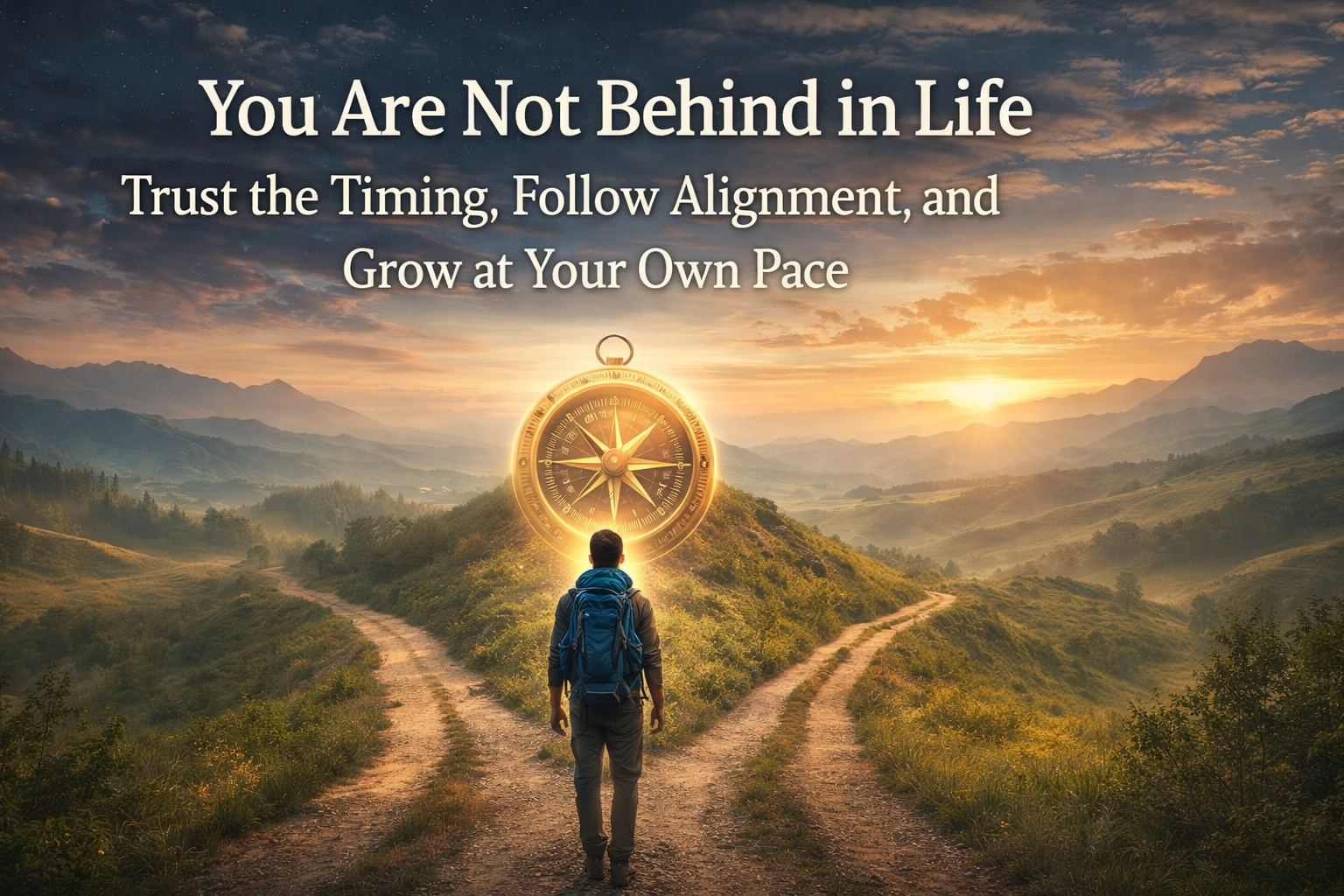
You are not behind because your path is influenced by factors that extend beyond chronological timelines, including readiness, alignment, and contextual relevance.
You are not late because progress is measured by integration rather than speed, and integration requires time for internal and external components to synchronise effectively.
You cannot lose what belongs to your path because alignment ensures that opportunities remain accessible until you are prepared to engage with them meaningfully.
Trusting the timing of your life involves recognising that delay can be a form of preparation rather than a sign of inadequacy.
Releasing what no longer fits creates space for elements that are more compatible with your evolving identity, and following what feels true facilitates growth that aligns with your long term objectives.
Alignment eventually finds you when you are ready to recognise and embrace it, making readiness a critical component of meaningful progress.
In a world that celebrates speed, choosing alignment may appear counterintuitive, yet it often leads to outcomes that are more sustainable, meaningful, and fulfilling over the long term.
You are not behind because you are becoming, and becoming requires time that cannot be compressed without compromising the integrity of the transformation that is taking place beneath the surface.