



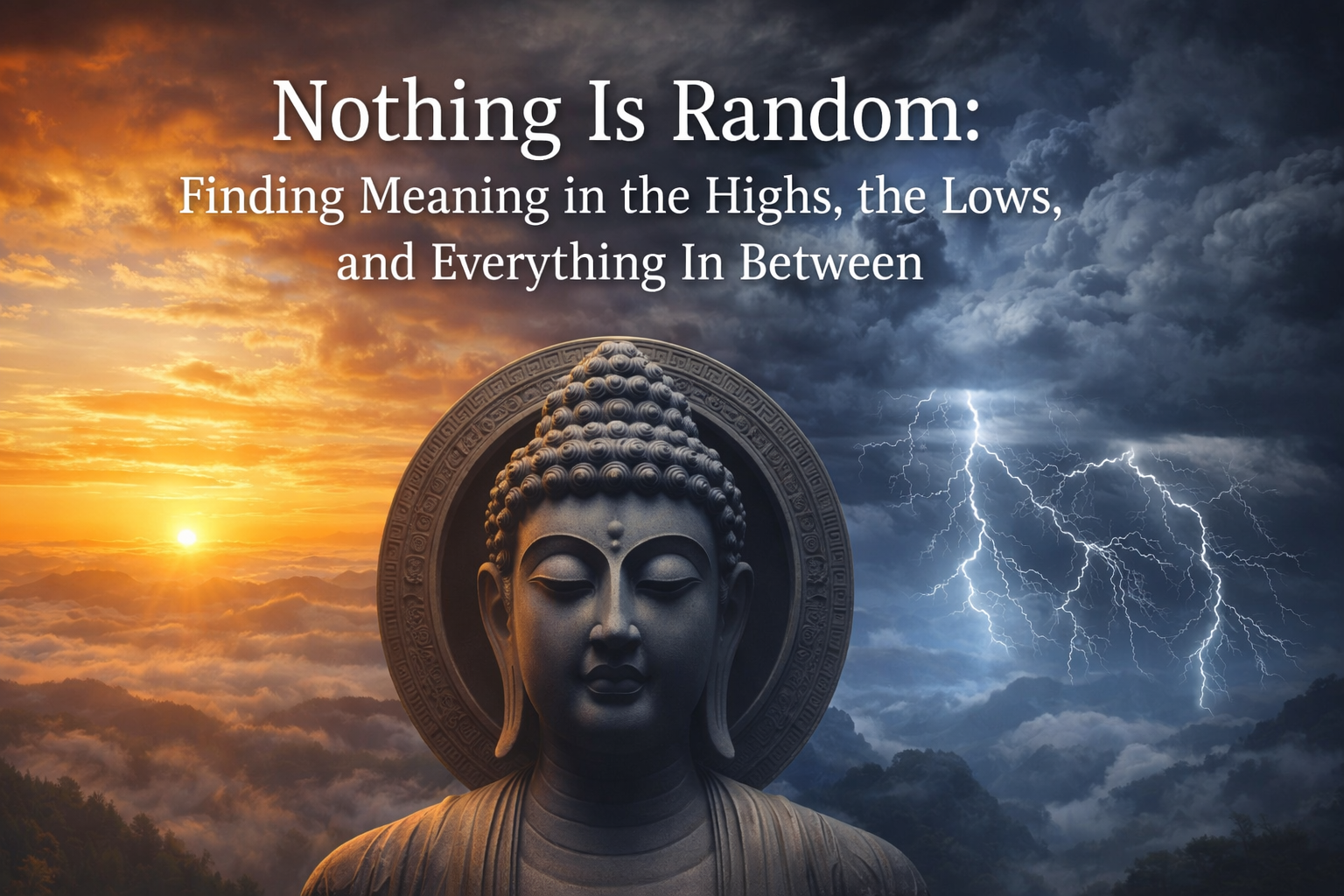
When Life Stops Following the Script You Wrote for It
There are moments in life when everything that once felt certain begins to slip through your hands without any clear warning, and the plans you had built so carefully start collapsing in ways that leave you wondering whether effort truly makes any difference at all.
Promotions that once felt guaranteed disappear into vague promises, relationships that once seemed permanent begin to drift without confrontation, and the future you imagined with confidence starts looking unfamiliar and distant.
In those moments, it becomes incredibly easy to believe that life is nothing more than a series of disconnected events that happen without logic or intention, because randomness feels easier to accept than the possibility that every experience might be shaping you for something that has not yet revealed itself.
Understanding the Meaning Behind Life’s Highs and Lows
Human beings naturally prefer predictable outcomes because predictability creates a sense of safety, and safety allows us to believe that our actions will always produce the results we desire if we simply remain consistent in our effort.
However, life rarely functions like a perfectly structured system where inputs produce clean and immediate outputs without delay or disruption.
It behaves more like a complex network where unexpected events force recalibration, and where performance under pressure often reveals truths that comfort keeps hidden.
Success often brings validation, but it also introduces responsibility that demands growth in ways we may not have anticipated. Failures, on the other hand, force reflection because they expose assumptions that success allowed us to ignore for far too long.
When everything works smoothly, weaknesses remain invisible, but when pressure increases beyond what we are prepared to handle, those same weaknesses become impossible to overlook.
The same principle applies in life because the moments that stretch us emotionally or mentally are usually the ones that highlight where resilience needs to be strengthened.
The Role of Challenges in Personal Growth and Self Development
Challenges rarely appear at convenient times, because growth does not follow the schedules we create for ourselves. Obstacles that seem unrelated to our goals may later prove essential in developing skills that were necessary for navigating future complexity.
Experiences that initially feel like setbacks often become the very situations that prepare us for opportunities that require emotional strength, patience, or adaptability.
Personal development does not occur during periods of comfort because comfort encourages repetition rather than transformation. It is through difficulty that individuals begin to reevaluate priorities, question inherited expectations, and develop new perspectives that align more closely with evolving values.
Tasks that once felt insignificant may acquire meaning when viewed as stepping stones toward something larger, and obstacles that once seemed frustrating may eventually reveal themselves as opportunities for deeper understanding.
People Who Enter and Leave Your Life Carry Lessons
Not everyone who enters your life is meant to stay, and not everyone who leaves does so because something went wrong. Some people arrive at precisely the moment when their presence can expand your confidence, challenge your boundaries, or introduce you to ideas that reshape the way you interpret the world.
Others appear during moments of stability and remain until circumstances change in ways that require both of you to move in different directions.
Departures often hurt more than arrivals because losing someone forces us to confront the emotional investments we made in their presence. It becomes difficult not to interpret absence as rejection or failure, even when circumstances simply shift beyond anyone’s control.
Yet there are times when the absence of a particular person creates the space required for new perspectives or opportunities to emerge, because emotional energy that was once occupied becomes available for growth that would otherwise remain delayed.
Why Difficult Phases Often Feel Meaningless at First
Heavy periods in life have the ability to distort perception because unresolved uncertainty can make temporary setbacks feel permanent and isolated events appear like defining patterns. During those stretches, the instinct to rush toward resolution becomes overwhelming, even though clarity often requires patience rather than immediate action.
The urge to fix everything at once can lead to decisions that prioritize short term relief over long term alignment, which mirrors the way individuals often choose quick solutions instead of addressing root causes. While those solutions may restore comfort temporarily, they often introduce new challenges that surface later when circumstances become more demanding.
The Importance of Reflection During Tough Times
Pausing during difficult phases does not mean surrendering to stagnation, because reflection creates the cognitive space necessary for recalibration that action alone cannot provide.
Taking time to reassess priorities allows individuals to separate genuine goals from inherited expectations that no longer align with their evolving sense of purpose.
Reflection also helps in recognizing patterns in one’s own responses to stress, which can inform healthier approaches when similar challenges arise in the future.
Emotional resilience develops through repeated exposure to adversity that encourages adaptation rather than avoidance, and over time this adaptation strengthens the capacity to navigate uncertainty with confidence.
How Life Lessons Guide You Toward Your Purpose
Lessons rarely present themselves in ways that are immediately recognizable, because they tend to emerge gradually through the accumulation of experiences that reshape assumptions about what matters most.
A failed attempt at something meaningful might reveal the importance of preparation or timing, while an unexpected opportunity might highlight the value of remaining open to paths that diverge from original plans.
Guidance toward purpose often arrives disguised as inconvenience or challenge that demands persistence. Tasks that once felt mundane may acquire significance when viewed as components of a larger journey, and obstacles that initially seem unrelated to your goals may later prove to have strengthened capabilities that were essential for navigating future complexity.
Embracing Uncertainty as Part of the Journey
Accepting that growth often occurs outside of comfort allows individuals to approach uncertainty with curiosity rather than fear, even when outcomes remain unclear.
The capacity to endure ambiguity without losing direction represents one of the most valuable skills in both professional and personal contexts, because progress frequently depends on experimentation rather than guarantees.
Believing that there is meaning in every experience does not require blind optimism or denial of genuine hardship. It simply invites individuals to remain receptive to insight that may not yet be visible, because patterns often become clear only after enough time has passed for perspective to develop.
Conclusion: Trust That There Is Meaning in This Too
When life feels heavy, taking a moment to breathe and reflect allows you to reconnect with the broader context that individual setbacks often obscure. Trusting that there is significance in the present moment, even when it remains undefined, encourages patience that can sustain effort until clarity arrives.
Over time, this approach fosters a mindset that views change not as disruption but as progression, allowing you to navigate uncertainty with greater confidence and purpose than you thought possible.
Recognizing that every high, every low, every arrival, and every departure carries meaning creates the foundation for resilience that supports growth long after circumstances have changed.