
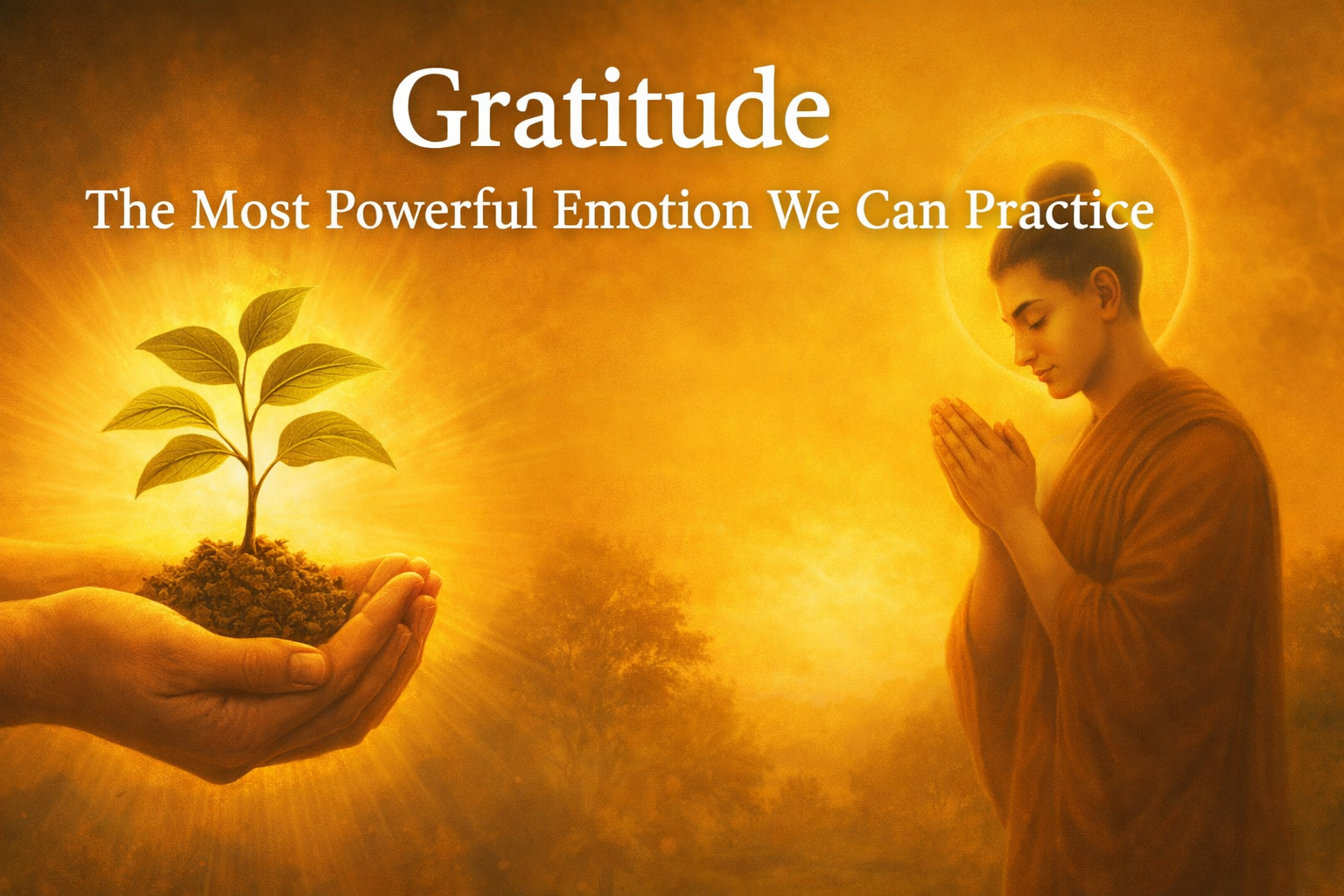
There are many emotions that move the human mind.
Joy excites us.
Fear protects us.
Anger pushes us to act.
Hope keeps us going when nothing else does.
Yet gratitude does something far more unusual.
It does not demand change from the world.
It changes the person experiencing it.
Gratitude does not arrive only when life becomes perfect.
It arrives when a person learns to see clearly even while life remains imperfect.
That is why gratitude stands apart from every other emotional state, because it does not depend on success, comfort, validation, or ease.
It depends on perception.
Most people believe happiness is the result of good circumstances, stable relationships, financial comfort, and emotional security.
This belief shapes how they chase happiness throughout their lives.
They wait for better days.
They wait for less struggle.
They wait for approval, achievement, or relief.
Gratitude works in the opposite direction.
It does not wait for life to soften before it appears.
It softens the mind so life becomes easier to carry.
Why Gratitude Feels So Rare in a Modern World
The modern world trains the human brain to notice what is missing far more than what is present.
From an early age, people are encouraged to improve, compete, upgrade, and move faster.
Improvement itself is not harmful, but when it becomes the only lens through which life is evaluated, contentment slowly disappears.
The mind begins to measure life in gaps.
What is not achieved yet.
What others have but we do not.
What could have gone better.
What should have happened differently.
This constant measurement creates a background dissatisfaction that many people accept as normal adulthood.
They learn to live with it without questioning where it came from.
Gratitude feels difficult in this state because the mind is always scanning for problems that need fixing rather than moments that deserve appreciation.
Gratitude requires a pause.
It requires attention.
It requires presence.
And presence has become one of the rarest human skills.
Gratitude Is Not Positive Thinking
One of the biggest misunderstandings about gratitude is the belief that it means ignoring pain, denying struggle, or pretending everything is fine.
That interpretation turns gratitude into emotional avoidance, which eventually collapses under reality.
Real gratitude does not deny hardship.
It acknowledges it honestly.
It simply refuses to let hardship become the only story worth telling.
A person can feel grief and still experience gratitude.
A person can struggle financially and still feel gratitude.
A person can carry disappointment and still feel gratitude.
Gratitude does not erase pain.
It balances it.
When gratitude is practiced correctly, it does not say, “Everything is good.”
It says, “Even here, something meaningful exists.”
That distinction changes everything.
Training the Brain to Recognize Value
The human brain is highly adaptable.
What it notices most frequently becomes its default focus.
If the brain is repeatedly trained to scan for danger, it becomes anxious.
If it is trained to scan for comparison, it becomes insecure.
If it is trained to scan for approval, it becomes dependent.
Gratitude trains the brain to scan for value.
This training does not happen through grand gestures or dramatic moments.
It happens through repetition.
Through daily recognition.
Through intentional attention.
When a person begins to acknowledge small moments of goodness, the brain slowly rewires itself to expect them.
A calm morning.
A completed task.
A supportive conversation.
A moment of clarity.
A breath taken without pain.
These moments were always present, but they were overlooked because the mind was occupied elsewhere.
Gratitude brings them back into awareness.
Over time, this shift changes emotional resilience.
Stress feels less overwhelming.
Disappointments feel less personal.
Challenges feel more manageable.
Not because life becomes easier, but because the mind becomes stronger.
Gratitude and Emotional Freedom
Many emotional struggles are rooted in resistance.
Resistance to what happened.
Resistance to what did not happen.
Resistance to how life unfolded compared to expectations.
Gratitude dissolves resistance gently.
It does not force acceptance.
It invites it.
When a person feels grateful for what exists, the internal argument with reality begins to soften.
This does not mean settling for less or abandoning ambition.
It means releasing the constant inner tension that comes from fighting what cannot be changed.
Emotional freedom does not come from controlling every outcome.
It comes from reducing the emotional cost of outcomes that were never fully controllable in the first place.
Gratitude lowers that cost.
Gratitude in Relationships
Relationships often suffer not because of major conflicts, but because appreciation fades.
Familiarity replaces awareness.
Expectations replace gratitude.
Over time, people stop noticing effort and begin noticing flaws.
They stop acknowledging consistency and begin focusing on occasional mistakes.
This shift slowly erodes connection.
Gratitude restores balance in relationships by changing how people see one another.
It encourages recognition instead of entitlement.
It brings attention back to what someone contributes rather than what they lack.
When gratitude is present in relationships, communication improves.
Patience increases.
Conflict becomes less destructive because appreciation creates emotional safety.
People feel seen again.
Gratitude and Personal Growth
Growth is often associated with discomfort, discipline, and pushing limits.
While all of these play a role, growth without gratitude leads to burnout.
The mind becomes obsessed with the next milestone and never experiences satisfaction in the present one.
Gratitude anchors growth.
It allows a person to move forward without feeling empty.
It reminds the mind that progress exists even when perfection does not.
This balance is essential for long-term motivation.
People who practice gratitude are less likely to quit when results are slow.
They are less likely to tie their worth to outcomes alone.
They are more likely to remain consistent.
Gratitude transforms effort into meaning rather than obligation.
Gratitude During Difficult Seasons
Some of the most profound gratitude emerges during difficult seasons, not because hardship is enjoyable, but because it strips life down to essentials.
During struggle, superficial desires fade.
What remains becomes clearer.
Health.
Support.
Time.
Strength.
Learning.
Gratitude in these moments is not about celebrating pain.
It is about recognizing survival.
It is about noticing what remains intact even when much feels uncertain.
This form of gratitude builds inner stability.
It teaches the mind that even in instability, value still exists.
That realization alone changes how future challenges are approached.
Gratitude and Happiness
Happiness often feels fragile because it is placed on external conditions.
Gratitude creates a more stable form of happiness because it is internal.
When gratitude becomes a habit, happiness becomes less reactive.
It no longer rises and falls dramatically with circumstances.
It becomes steadier.
Quieter.
More reliable.
This does not mean constant joy or emotional numbness.
It means emotional balance.
People who practice gratitude still feel sadness, frustration, and disappointment.
They simply recover faster.
They do not stay trapped in emotional spirals as long.
That recovery is what many people mistake for happiness.
Living With Gratitude Daily
Practicing gratitude does not require special rituals or dramatic lifestyle changes.
It requires attention.
Noticing when something goes right instead of only when something goes wrong.
Acknowledging effort instead of dismissing it.
Appreciating progress instead of waiting for completion.
Over time, this awareness becomes automatic.
The brain begins to recognize value instinctively.
Life feels fuller without needing to become easier.
Gratitude becomes a lens rather than an exercise.
Final Reflection
Gratitude is not an emotion reserved for fortunate people.
It is a skill developed by aware people.
It does not promise a life without difficulty.
It promises a life where difficulty does not consume everything else.
When gratitude becomes a daily practice, happiness stops feeling like a distant goal and begins to feel like a byproduct of how life is experienced in each moment.
And that is why gratitude remains one of the most powerful emotional practices available to the human mind.