





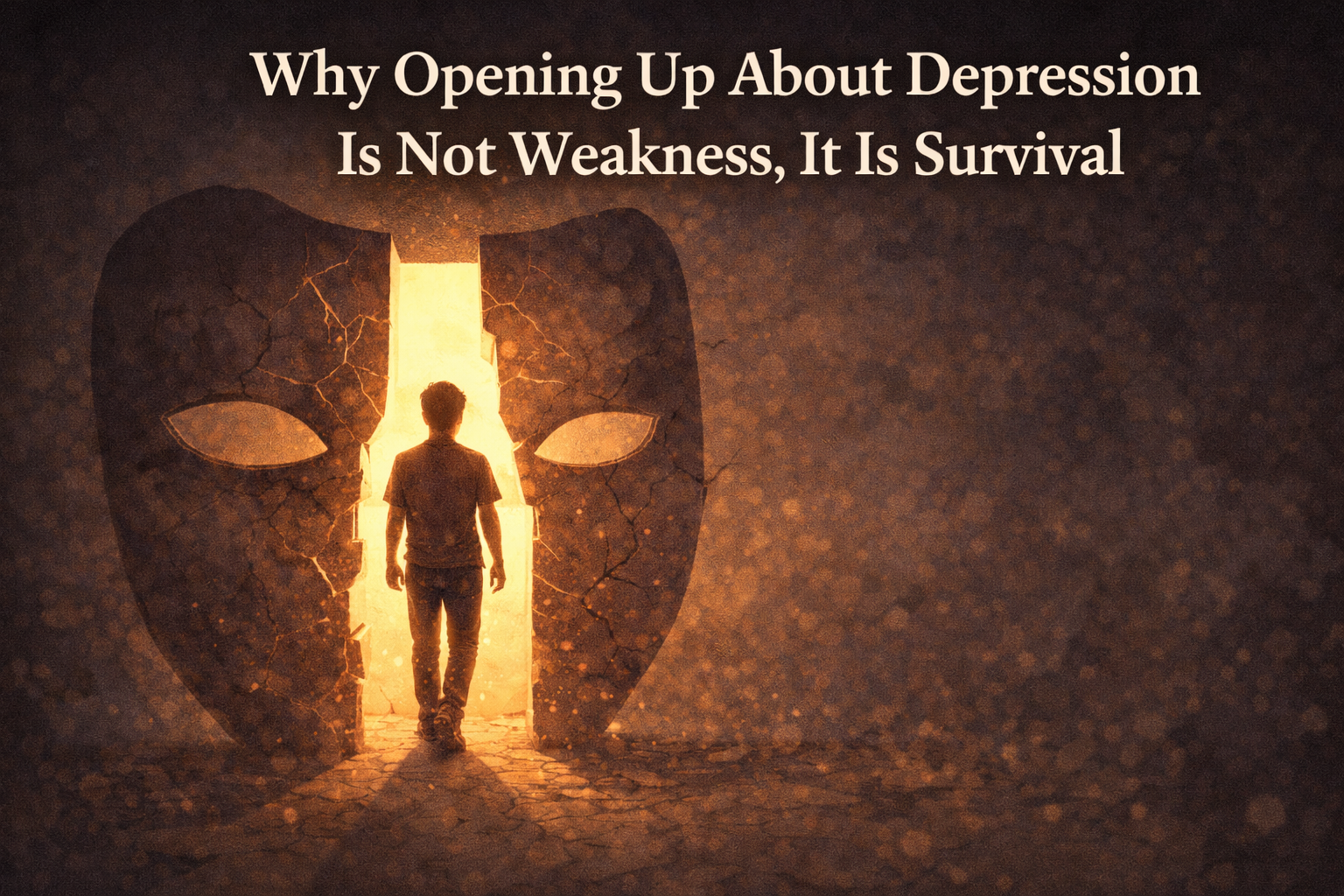
Depression has a way of making itself invisible. Not invisible in the sense that it disappears, but invisible in the sense that it hides behind routine, responsibility, and the version of you that keeps showing up even when everything inside feels unbearably heavy. Many people living with depression still go to work, still answer messages, still attend family gatherings, and still smile when expected. From the outside, nothing seems obviously wrong. From the inside, everything feels like it requires far more effort than it should.
This is one of the reasons opening up about depression feels so difficult. When you are still functioning, you begin to doubt your own pain. You tell yourself that if you can still meet deadlines, still pay bills, and still laugh occasionally, then maybe you are just overreacting. You convince yourself that other people have it worse, that you should be grateful, and that saying anything would make you look dramatic or ungrateful.
Depression thrives in that internal argument. It feeds on comparison and silence. It grows stronger when you dismiss your own experience and decide to carry it alone.
Opening up is often framed as something brave, but that framing can be misleading. For many people, opening up is not about courage or confidence or self-expression. It is about survival. It is about acknowledging that continuing to pretend everything is fine is slowly draining the life out of you.
How Depression Trains You to Stay Silent
One of the most damaging aspects of depression is not just how it makes you feel, but how it changes the way you think about your feelings. It convinces you that your emotions are inconvenient, excessive, or unnecessary. It tells you that you should be able to handle this on your own, especially if you have handled other difficult things in the past.
Many people who struggle with depression are also the ones others rely on. They are the responsible ones, the dependable ones, the ones who do not usually fall apart. Because of that identity, admitting that you are struggling feels like a betrayal of who you are supposed to be. You start believing that asking for help means you are failing at being strong.
This belief keeps people silent for years.
Silence then turns into isolation, even when people are physically present in your life. You may still talk to others, but the conversations stay on the surface. You avoid mentioning how drained you feel, how empty your days have become, or how much effort it takes just to get through ordinary moments. Over time, this creates a growing gap between who you are on the inside and who you present to the world.
That gap is exhausting to maintain.
The Emotional Cost of Carrying Everything Alone
Holding everything inside does not make depression go away. It compresses it. When emotions are constantly suppressed, they do not disappear, they accumulate. This accumulation shows up in subtle ways before it shows up in obvious ones.
You might find yourself snapping over small things, feeling irritated without knowing why, or withdrawing from people you care about because social interaction feels overwhelming. You might struggle to concentrate, feel permanently tired, or notice that even activities you once enjoyed now feel meaningless. None of this happens because you are broken. It happens because emotional pressure without release eventually leaks into every part of your life.
People often believe that talking about depression will make it worse, as if naming the pain will somehow increase it. In reality, the opposite is often true. Expressing what you are feeling creates movement. It prevents your thoughts from looping endlessly in your head and gives them a place to land.
You do not need answers for this to help. You do not need solutions. You do not even need encouragement. Sometimes the act of saying, out loud, that you are struggling is enough to reduce the intensity of what you are carrying.
Why Being Understood Matters More Than Being Fixed
A common fear around opening up is the expectation that the other person will try to fix you. Many people hesitate to talk because they do not want advice, motivational speeches, or comparisons to someone else’s struggles. They worry that opening up will lead to awkward conversations or dismissive responses.
While those fears are valid, they also hide an important truth. Support does not require perfect understanding or perfect responses. It requires presence.
Being listened to without interruption, without judgement, and without minimisation has a powerful psychological effect. It reminds you that your experience is real and that it matters. When someone takes your pain seriously, it helps you take your own pain seriously as well.
This is especially important for people who have spent years invalidating themselves. Depression already tells you that your feelings are wrong or exaggerated. Having another person quietly acknowledge that what you are experiencing is difficult can interrupt that narrative in a way nothing else can.
Shame Is Often the Real Barrier, Not Fear
People often say they are afraid to open up, but fear is not always the strongest emotion involved. Shame is. Shame convinces you that your depression says something bad about who you are. It frames your struggle as a personal flaw instead of a human response to stress, loss, trauma, or long-term pressure.
When shame is present, silence feels safer than honesty. You would rather suffer privately than risk being judged, misunderstood, or labelled. Unfortunately, shame grows stronger in isolation. The less you speak about what you are experiencing, the more distorted your view of yourself becomes.
Speaking openly challenges shame because it exposes it to reality. When someone responds with empathy instead of judgement, the internal story that you are weak or defective begins to lose credibility. You start to see that depression is not a moral failing, but a condition that deserves care and attention.
This shift does not happen instantly, but it cannot happen at all if you never speak.
Talking Helps You Make Sense of What You Feel
Depression is rarely neat or logical. Feelings overlap, contradict each other, and change from day to day. One moment you feel empty, the next you feel anxious, and then suddenly you feel guilty for feeling anything at all. When all of this stays inside your head, it can feel overwhelming and impossible to untangle.
Talking externalises your thoughts. It allows you to hear yourself describe what you are going through, which often brings clarity you did not have before. Patterns start to emerge. You notice what triggers your low moods, what situations drain you most, and what moments offer even small relief.
This process is not about analysing yourself or turning your life into a case study. It is about understanding your internal experience well enough to respond to it with compassion rather than frustration. Many people discover, through conversation, that what they thought was random sadness is actually connected to unmet needs, unresolved stress, or emotional exhaustion they have been ignoring.
That understanding is a form of power.
Opening Up Creates a Path Toward Real Help
Another reason people stay silent is because they are unsure what help would even look like. They worry that if they admit they are struggling, they will be pushed into decisions they are not ready for or labelled in ways they do not want. As a result, they choose to do nothing.
What often gets overlooked is that opening up does not lock you into any specific outcome. It simply creates options.
When others know you are struggling, they can help in practical ways you might not be able to manage alone. They can encourage you to speak to a professional, help you navigate appointments, or simply check in regularly so you do not feel forgotten. Early support often prevents depression from becoming more severe, but that support cannot exist if nobody knows what you are dealing with.
You do not need to wait until you reach a breaking point to deserve help. Struggling is enough.
Vulnerability Builds Strength Over Time
Opening up does not become easy overnight. It is uncomfortable, especially if you are used to handling everything independently. The first conversation might feel awkward or incomplete. You might not find the right words. You might worry afterward that you said too much or not enough.
That discomfort does not mean you did something wrong. It means you did something unfamiliar.
Each time you allow yourself to be honest about your mental state, you strengthen your ability to tolerate vulnerability. Over time, this reduces the fear associated with your own emotions. You learn that feeling deeply does not destroy you and that expressing those feelings does not make you lose control.
This emotional resilience becomes valuable far beyond depression. It affects how you handle conflict, stress, and uncertainty in all areas of life.
You Do Not Owe Everyone Your Story
Opening up does not mean making your pain public or explaining yourself to people who have not earned your trust. You are allowed to be selective. You are allowed to protect your energy. One honest conversation with one safe person can be enough to start the healing process.
You also do not need to share everything at once. You can speak in general terms. You can say that you have been struggling without explaining why. You can say you are not okay without having a clear explanation for what that means.
Your experience does not need to be fully formed or fully understood before you share it.
When Opening Up Feels Risky
It is important to acknowledge that not every response will be supportive. Some people lack the emotional tools to handle conversations about mental health. Others may minimise your experience or try to offer solutions when what you need is understanding.
If you open up and feel dismissed, that does not mean opening up was a mistake. It means that particular person was not the right listener. Support is not about convincing everyone to understand you. It is about finding the people who can meet you with empathy.
If speaking to friends or family feels unsafe, professional support exists for this exact reason. Therapists, counsellors, and mental health professionals are trained to hold these conversations without judgement.
How to Begin When You Feel Stuck
If you want to open up but feel overwhelmed by the idea, start small. You do not need to explain your entire emotional history. You can begin with a single sentence that feels manageable.
You might say that you have been feeling low for longer than usual. You might admit that you are struggling to cope even though everything looks fine on the surface. You might say that you feel emotionally exhausted and do not know what to do about it.
If speaking feels too difficult, writing can be a gentler starting point. A message or letter gives you time to choose your words without the pressure of an immediate response.
The goal is not to say everything perfectly. The goal is to stop facing everything alone.
Final Reflection
Depression convinces people to disappear emotionally while still showing up physically. It teaches silence, self-doubt, and isolation, all while pretending these things are forms of strength. They are not.
Opening up is not about seeking attention or creating drama. It is about acknowledging reality. It is about choosing honesty over endurance and connection over isolation.
You do not need to have the worst story. You do not need permission. You do not need to wait until you completely fall apart.
You only need to recognise that your mental health matters, and that carrying everything alone is not a requirement for being strong.
Sometimes the most responsible thing you can do for yourself is to speak.