




There is something strangely painful about the moment you realise you are no longer reacting to life normally.
It usually happens in ordinary situations. Nothing dramatic. Nothing cinematic. No huge tragedy unfolding in the background with emotional music playing like a movie scene.
Sometimes it happens while standing in the kitchen after a long day when a spoon falls on the floor and suddenly you feel anger rising far beyond what the situation deserves.
Sometimes it happens in traffic when one more red light feels personally offensive.
Sometimes it arrives through tears that appear out of nowhere because someone replied with a cold text message or because one more task was added to an already exhausting week.
Then comes the confusion.
You sit there wondering why something so small affected you so deeply.
You replay the situation in your head.
You criticise yourself for being “too emotional” or “too sensitive” or “unable to handle basic life.”
You promise yourself to stay calmer next time.
You tell yourself other people manage life better than you do.
But most of the time, the issue is not the small event that finally triggered the reaction.
The issue is everything that had already been building silently underneath it.
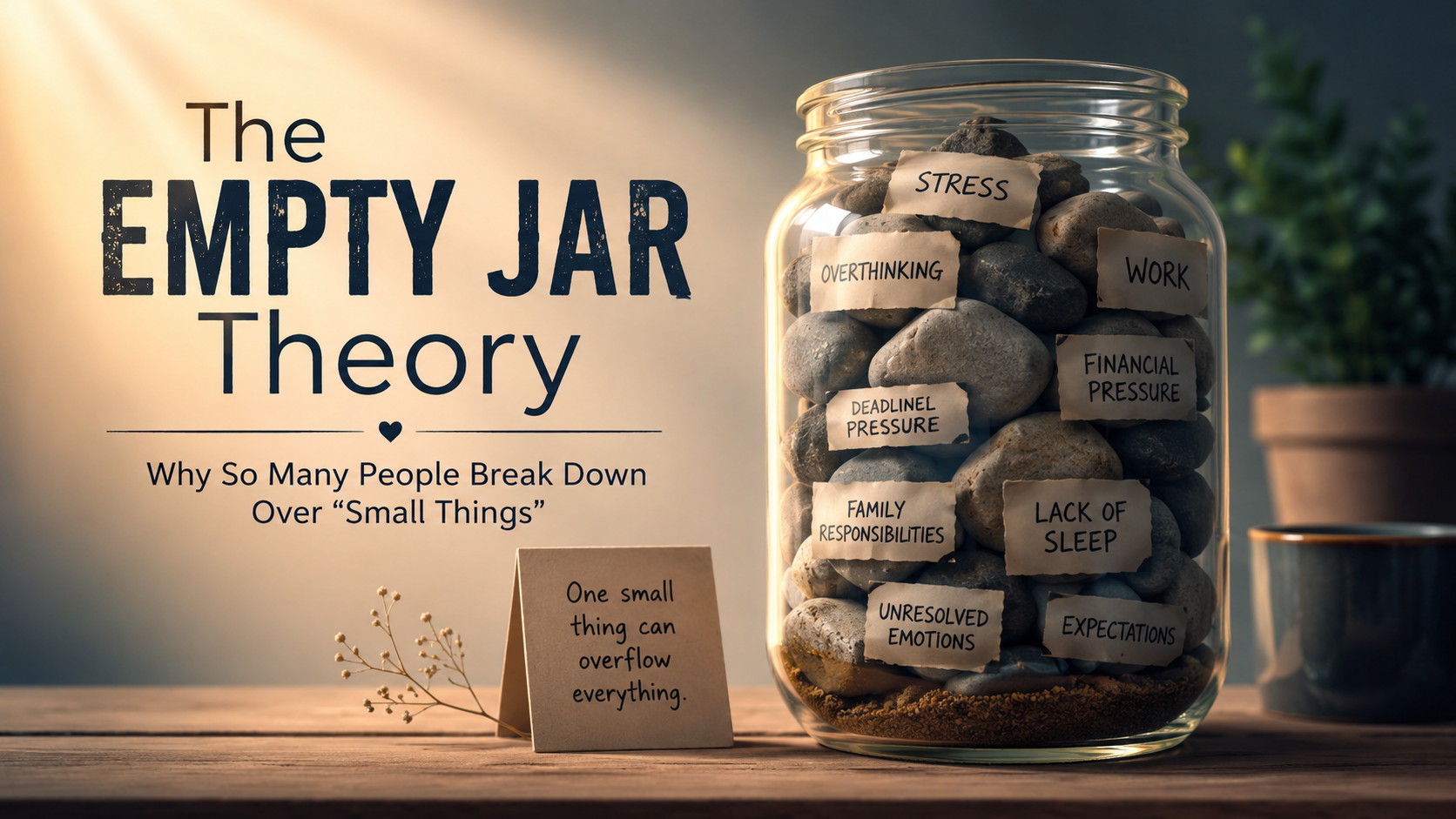
That is the heart of what many people call the Empty Jar Theory. It is one of the simplest ways to explain emotional overload, stress accumulation, burnout, and human behaviour without turning emotions into some complicated psychological puzzle. The idea sounds almost childishly simple at first, but the more you think about it, the more you begin to see your entire life differently.
Imagine carrying an invisible jar inside yourself every single day. Every responsibility, disappointment, unresolved conversation, financial pressure, difficult relationship, anxiety about the future, lack of sleep, ignored emotion, work deadline, family expectation, and personal frustration slowly gets placed inside that jar.
Some experiences are tiny drops. Others are heavy stones.
Some days barely affect you at all. Other days feel like someone dumped half a mountain into your chest before lunchtime.
The important part is this.
Most people keep functioning long after the jar is already close to full.
That is why emotional overload can be so difficult to recognise from the outside. Humans are remarkably skilled at pretending they are fine. They go to work. They attend meetings. They smile politely. They answer emails. They post normal pictures online. They continue paying bills and replying “I’m good” when somebody asks how they are doing.
Meanwhile, internally, the jar is reaching its limit.
Then one tiny thing happens.
A glass breaks.
Someone interrupts them at the wrong moment.
Their child refuses to listen.
Their partner forgets something unimportant.
A colleague sends one more annoying message.
And suddenly the jar overflows.
The people watching from the outside only see the final reaction. They assume the reaction was caused entirely by the small event itself. What they never see is the hundreds of invisible things that were already sitting inside the jar long before that final moment arrived.
That misunderstanding creates one of the biggest emotional problems in modern life because people start judging themselves based on isolated moments instead of accumulated pressure. They convince themselves they are weak instead of overloaded. They begin treating emotional exhaustion like a character flaw instead of recognising it as a warning signal.
The difference between those two interpretations matters more than most people realise.
If you believe you are weak, you attack yourself.
If you believe you are overloaded, you start caring for yourself differently.
One path creates shame. The other creates awareness.
And shame is dangerous because it turns normal human limits into personal failures.
Many people live this way for years without understanding what is happening to them. They keep adding more responsibilities while removing the very things that help empty the jar. They stop resting properly. They stop exercising. They stop talking honestly about how they feel. They stop doing things that once brought them joy because productivity slowly becomes more important than recovery.
Modern life almost rewards this behaviour.
People praise burnout as ambition.
They celebrate exhaustion as dedication.
They admire people who are constantly available, constantly working, constantly sacrificing themselves for everyone else.
Then they act surprised when those same people suddenly collapse emotionally over something small.
But human beings were never designed to carry endless emotional weight without release.
Even machines need cooling systems. Even phones warn you when storage is full. Even engines break down when maintenance is ignored for too long. Yet somehow people expect themselves to function endlessly without emotional consequences.
The human nervous system does not work that way.
Pressure accumulates.
Stress accumulates.
Emotions accumulate.
And eventually, if nothing is released, overflow becomes unavoidable.
One of the most powerful things about the Empty Jar Theory is that it changes the question people ask themselves after emotional moments. Most people instinctively ask, “Why did I react so badly to that?” But that question often leads nowhere because it focuses entirely on the final trigger.
A better question is, “What had already been filling my jar before this happened?”
That question changes the conversation completely.
Maybe you had been sleeping badly for weeks.
Maybe work had been draining every ounce of mental energy from you.
Maybe you had been carrying grief you never fully processed.
Maybe you were constantly taking care of everyone else while ignoring yourself.
Maybe financial stress had been sitting in the background of every decision you made.
Maybe you had spent months pretending to be stronger than you actually felt.
Suddenly the reaction begins to make sense.
Not because the small trigger was huge, but because the jar was already full before the trigger even arrived.
This idea becomes especially important when thinking about children because children often experience emotional overflow without having the vocabulary to explain it. Adults expect children to communicate complex emotional states clearly even though many adults cannot do it themselves.
A child does not usually say, “I am emotionally overstimulated and mentally exhausted after suppressing my feelings all day.”
A child screams because the wrong cereal was served.
Adults laugh at this because the trigger appears ridiculous. But children often react exactly the same way adults do. Their jar fills too. School pressure, social anxiety, overstimulation, tiredness, emotional confusion, and fear all build up inside them until one small thing becomes the breaking point.
That is why the jar metaphor works so well for families. It turns emotions into something visible instead of mysterious. A parent can ask a child whether their jar feels empty, half full, or overflowing. Suddenly the child has a way to describe emotions without needing advanced emotional language.
Honestly, many adults need that same conversation with themselves.
Because one of the saddest habits people develop is learning how to ignore their own emotional state until their body forces them to pay attention. They wait until panic attacks appear. Until exhaustion becomes unbearable. Until relationships begin suffering. Until they start feeling emotionally numb. Until joy disappears from things they once loved.
Only then do they stop and ask what is wrong.
But emotional maintenance was never supposed to begin at collapse.
That is why learning how to empty the jar matters just as much as understanding what fills it.
The mistake many people make is believing emotional recovery must always involve dramatic life changes. They imagine quitting jobs, moving cities, disappearing into nature for six months, or completely rebuilding their lives overnight. Sometimes major change is necessary, but often recovery begins through smaller and more sustainable actions repeated consistently over time.
For some people, emptying the jar happens through long walks where nobody demands anything from them. For others, it happens during honest conversations where they finally stop pretending everything is okay. Some people empty the jar through exercise because movement gives stress somewhere physical to go. Others find relief in journaling, prayer, music, therapy, cooking, reading, painting, gardening, or simply sitting alone without noise for a while.
The activity itself matters less than the emotional release it creates.
The deeper problem is that many people never allow themselves permission to empty the jar at all because they have attached guilt to rest. They feel selfish for needing space. They feel lazy for slowing down. They feel weak for admitting they are overwhelmed.
So instead, they continue carrying emotional weight until life eventually forces a shutdown they can no longer ignore.
Another difficult truth hidden inside this theory is that boundaries are not selfish. Boundaries are often the difference between functioning and drowning.
Every unnecessary obligation adds something into the jar.
Every forced yes when you desperately wanted to say no adds something into the jar.
Every relationship where you constantly absorb negativity without protection adds something into the jar.
People often imagine boundaries as aggressive walls built to push others away. In reality, healthy boundaries are usually much simpler than that. They are honest acknowledgements of human capacity.
They sound like this:
“I can’t take that on right now.”
“I need some time to myself.”
“I’m already overwhelmed.”
“That does not work for me.”
Simple sentences. But life-changing ones.
Because sometimes the strongest thing a person can do is stop volunteering themselves for unnecessary emotional weight.
The beautiful thing about understanding emotional overflow this way is that it replaces self-hatred with curiosity. Instead of attacking yourself for struggling, you begin observing yourself more compassionately. You notice patterns. You recognise warning signs earlier. You stop treating breakdowns like random failures and start seeing them as signals.
And honestly, that awareness alone can change a life.
Because healing rarely looks like becoming emotionally invincible. Real healing usually looks much less dramatic than that. It looks like recognising overload earlier. It looks like resting before collapse instead of after it. It looks like communicating honestly before resentment builds. It looks like giving yourself permission to be human instead of expecting yourself to operate like a machine.
The jar may never stay completely empty because life itself guarantees stress, uncertainty, disappointment, and pressure. But understanding how the jar works gives you a chance to stop living permanently on the edge of overflow.
And perhaps that is the most important lesson hidden inside this simple idea.
People are not weak because they eventually reach capacity.
They are human because they do.