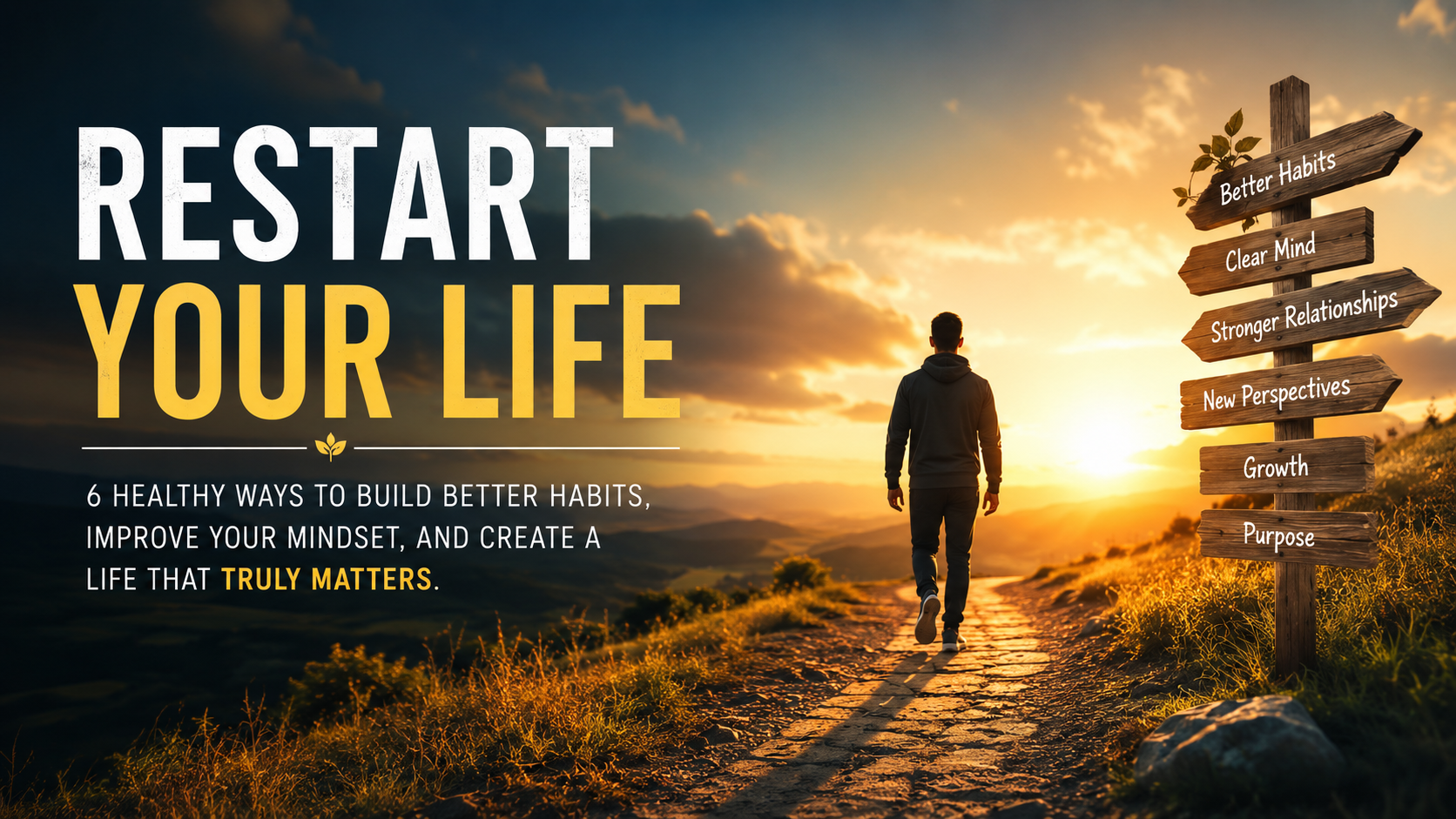





There comes a moment in life when you look around and feel that something has to change, not because your entire life is broken, but because the way you are living no longer feels aligned with the person you want to become. It may arrive after a difficult season, a personal failure, a health scare, a career disappointment, a broken relationship, or simply after months of feeling stuck in the same loop.
You wake up, repeat the same routines, react to the same triggers, carry the same mental weight, and wonder why change feels so hard even when the desire for change is very real.
Restarting your life does not always mean moving cities, quitting your job, cutting everyone off, deleting social media, and announcing a dramatic new version of yourself to the world. Real life is not a motivational movie trailer. Most meaningful change begins in smaller places.
It begins in how you sleep, how you speak to yourself, how you spend your attention, who you allow into your space, and what kind of environment you build around your future self.
The problem is that people often confuse life change with emotional intensity. They wait for motivation to arrive like a thunderstorm. They promise themselves they will transform everything from Monday morning.
New routine. New diet. New mindset. New body. New personality. New everything.
Then by Thursday, reality walks in wearing slippers, carrying bills, deadlines, tiredness, family responsibilities, and a very persuasive craving for comfort. The grand plan collapses, and the person feels like they failed again.
The truth is less glamorous but far more useful. Motivation helps you begin, but systems help you continue. Discipline matters, but structure makes discipline easier. Willpower has a role, but your surroundings, habits, relationships, and identity shape your behavior more than most people admit.
A healthy restart is not about punishing your old self. It is about creating conditions where your next version has a realistic chance to grow.
Build systems, not just discipline
Discipline sounds powerful because it makes change feel heroic. We imagine disciplined people as those who wake up before sunrise, drink green liquids without complaining, read philosophy before breakfast, and never lose control around chocolate biscuits. But in real life, even disciplined people rely on systems. They do not win every day because they have superhuman self-control. They win because their routines reduce friction.
If you want to restart your life, begin by building small systems that support the basics. Your body and mind need rhythm before they can handle ambition. Sleep, movement, hydration, food, learning, and focused work are not boring lifestyle details. They are the foundation that decides whether your goals feel possible or impossible.
A system is simply a repeatable structure that makes the right action easier. For example, if you want to read more, do not rely on a sudden intellectual awakening at 10 p.m. after scrolling for two hours. Keep a book beside your bed, set a realistic reading window, and start with ten pages. If you want to exercise, do not design a two-hour gym routine inspired by people whose full-time job is looking athletic online. Start with a walk, a short home workout, or a manageable routine you can repeat even when your energy is not impressive.
The point is consistency over intensity. Intensity feels exciting, but consistency changes your identity. A person who walks twenty minutes every day for six months usually changes more than someone who punishes themselves with an extreme routine for ten days and then disappears into exhaustion. Small actions become evidence. Evidence becomes belief. Belief becomes identity.
This is why your habits must be easy enough to survive tired days. Anyone can follow a perfect routine on a good day. The real test is what remains when your mood is average, your energy is low, and life is not clapping for your transformation. A healthy system accounts for normal human weakness. It does not expect you to behave like a productivity robot with a protein shaker.
Restarting your life begins when you stop asking, “How do I become more disciplined?” and start asking, “How do I make the right behavior easier to repeat?”
Practice self-compassion, not self-judgment
Many people try to restart their lives from a place of shame. They look at their past choices and speak to themselves with a cruelty they would never use toward a friend. They call themselves lazy, stupid, weak, behind, broken, or hopeless. They believe harshness will create improvement. For a short time, it may create pressure. But pressure is not the same as growth.
Self-compassion is often misunderstood as making excuses. It is not. It does not mean pretending your mistakes were fine or avoiding responsibility. It means looking at your past with honesty without turning that honesty into self-destruction. There is a major difference between saying, “I made poor choices, and I need to change,” and saying, “I am a failure, and nothing good can come from me.”
Your past actions were shaped by the knowledge, tools, emotional capacity, and environment you had at the time. That does not erase responsibility, but it does add context. Maybe you were coping badly. Maybe you were overwhelmed. Maybe you lacked support. Maybe you did not know how to handle pain, rejection, stress, or fear. Maybe you repeated patterns because they were familiar, not because they were healthy.
A useful restart requires you to separate who you are from what you did. You can regret a decision without becoming the decision. You can accept that a chapter was messy without deciding the whole book is ruined. When you reduce yourself to your worst moments, you remove the emotional space needed for change.
A better question is not, “Why am I like this?” That question often leads to shame spirals and dramatic overthinking. A better question is, “What did this teach me?” That question gives pain a job. It turns regret into information. It turns mistakes into feedback. It helps you carry lessons forward without dragging the entire punishment with you.
Self-compassion reduces self-sabotage because it keeps you engaged with growth. Harsh self-criticism often leads to avoidance. When people feel terrible about themselves, they hide, delay, numb, or give up. When they feel accountable but still worthy, they are more likely to try again.
Restarting your life does not require hating your old self. In fact, hatred usually keeps you tied to the same patterns. Change becomes healthier when it begins with responsibility and respect at the same time.
Create space for reflection
Modern life makes it very easy to avoid yourself. There is always another notification, another video, another message, another task, another opinion, another distraction pretending to be urgent. You can go through an entire day reacting to everything and never once ask yourself what is actually happening inside you.
Reflection is where clarity begins. Without it, you may keep changing external things while repeating the same internal patterns. You may change jobs but keep the same burnout cycle. You may leave one relationship and carry the same attachment wounds into the next one. You may set new goals while running from the same fear of failure.
Creating space for reflection does not mean disappearing into a mountain cabin with a leather journal and dramatic weather. It can be simple. You can spend fifteen minutes in the morning writing what is on your mind. You can take a walk without headphones. You can sit after work and ask yourself what drained you, what helped you, what triggered you, and what needs attention.
Journaling is useful because thoughts become clearer when they leave your head and land on paper. Inside your mind, everything can feel tangled. On paper, patterns become visible. You may notice that every time you skip sleep, your confidence drops. You may notice that one person always leaves you emotionally exhausted. You may notice that you are not lazy, but mentally overloaded. You may notice that you do not need a new life plan. You need boundaries, rest, and better priorities.
Reflection also improves decision-making because it creates a pause between reaction and response. Many people do not make bad decisions because they lack intelligence. They make bad decisions because they are tired, triggered, rushed, or desperate for relief. Reflection gives you a chance to understand the emotional engine behind your choices.
A healthy restart needs honest observation. Not dramatic self-analysis. Not endless overthinking. Just regular check-ins with your own life. The goal is to notice what is happening before it becomes a crisis.
Design your environment to support change
People love talking about willpower because it makes success sound personal and failure sound moral. But your environment has a huge influence on your behavior. Your surroundings either support the person you want to become or quietly pull you back into the person you are trying to outgrow.
If your phone is beside your bed, your day may begin with other people’s thoughts before you have even met your own. If unhealthy snacks are always visible, you will need willpower every time you pass the kitchen. If your workspace is chaotic, your brain has to fight extra friction before it can focus. If your social feeds are full of comparison, outrage, and noise, your mindset will pay the price.
Designing your environment is not about creating a perfect aesthetic life where every object matches and your desk looks like a productivity influencer’s dream. It is about reducing friction for good habits and increasing friction for old patterns.
Place your walking shoes where you can see them. Keep a water bottle near your desk. Put your journal where your hand naturally reaches in the morning. Charge your phone away from your bed. Remove apps that trigger mindless scrolling. Keep your workspace simple enough that your brain does not feel crowded before work begins.
The same idea applies to emotional environments. If certain conversations always pull you into drama, reduce your exposure. If certain places make you feel worse about yourself, question how much time they deserve. If your home has become a storage unit for unfinished emotions and unused items, begin with one drawer, one shelf, one corner.
Your environment does not need to be perfect. It needs to be supportive. Small design choices can save you from fighting the same battles every day. When the right action is easier and the wrong action is less convenient, change stops depending entirely on mood.
Evaluate your relationships
The people around you influence your standards, habits, confidence, and emotional patterns. This does not mean you should treat relationships like a business spreadsheet and remove anyone who is not helping you “level up.” That mindset can become cold and transactional. Human relationships are more complex than that. People go through seasons. Everyone has flaws. Nobody exists purely to support your growth.
Still, it is important to be honest about the emotional climate created by the people closest to you. Some people make you feel grounded, capable, and respected. Some people make you feel small, guilty, confused, or constantly drained. Some encourage your growth. Others feel threatened by it because your change disturbs the version of you they were comfortable with.
Restarting your life often requires relationship evaluation, not dramatic rejection. Ask yourself who supports your better habits, who respects your boundaries, who gives constructive feedback, and who only appears when they need something. Ask yourself who celebrates your progress without turning it into competition. Ask yourself who leaves you feeling more like yourself and who leaves you recovering for hours.
Boundaries are part of healthy change. A boundary is not always a loud announcement. Sometimes it is a shorter conversation, a slower reply, a declined invitation, or a decision not to explain yourself to someone committed to misunderstanding you. Boundaries protect the energy required for growth.
At the same time, seek people who challenge you in constructive ways. Comfort is lovely, but growth also needs honest mirrors. You need people who can tell you the truth without humiliating you, support your progress without controlling it, and remind you of your standards when you are tempted to shrink back into familiar patterns.
A life restart becomes harder when your relationships constantly pull you toward your old identity. It becomes healthier when your circle makes growth feel normal, not strange.
Shift your identity gradually
Real change lasts when you begin to see yourself differently. Goals are useful, but identity is stronger. A goal says, “I want to write.” Identity says, “I am becoming a writer.” A goal says, “I want to get fit.” Identity says, “I am the kind of person who takes care of my body.” A goal gives direction. Identity creates continuity.
The mistake many people make is trying to claim a new identity before building any evidence for it. They announce huge transformations, then feel crushed when their behavior does not immediately match the announcement. Identity change works better when it is built through repeated small actions.
Start by replacing fixed labels with growth-based language. Instead of saying, “That is just how I am,” say, “I am learning to respond differently.” Instead of saying, “I am not disciplined,” say, “I am building better systems.” Instead of saying, “I always fail,” say, “I am practicing consistency after setbacks.” This is not fake positivity. It is a more accurate way to describe a person in progress.
Then act like the person you want to become in small ways. If you want to be healthier, make one healthier choice today. If you want to be calmer, pause before one reaction. If you want to be more focused, protect one block of time. If you want to be more confident, keep one promise to yourself. These actions may look small, but they are votes for a new identity.
Setbacks will happen. Progress is not linear. You will have days when old habits return, when motivation drops, when you react poorly, when you choose comfort over growth. That does not mean the restart has failed. It means you are human. The important part is not avoiding every setback. The important part is returning faster, learning honestly, and refusing to turn one bad day into a full emotional collapse.
Identity-based change is sustainable because it moves beyond temporary goals. You are not just trying to complete a challenge. You are becoming someone who lives differently.
Final thoughts
Restarting your life is not about becoming a completely different person overnight. It is about building a life that supports the person you are ready to become. That process is slower than fantasy, but stronger than hype. It asks you to build systems instead of worshipping motivation, practice self-compassion instead of drowning in judgment, create space for reflection instead of reacting all day, design your environment instead of fighting constant friction, evaluate relationships instead of carrying every emotional weight, and shift your identity through repeated action instead of dramatic promises.
The most powerful restarts rarely look impressive from the outside at first. They look like going to bed on time. Drinking water. Taking a walk. Writing honestly. Saying no. Cleaning one corner. Choosing better company. Trying again after a bad day. Keeping one small promise when nobody is watching.
That is how a life changes. Not through one grand announcement, but through a series of ordinary choices that slowly become a new standard. You do not need to destroy your old life to begin again. You need to stop abandoning yourself inside it.