


There comes a time in life when the heart finally understands what the mind has been trying to say for years. You can love people with full honesty, stand beside them through storms, give your time before they ask, offer comfort before they admit they are hurting, forgive more than they deserve, and still find yourself standing at the edge of someone’s life like a guest who was never fully welcomed.
At first, you do not notice it. You think love means giving more. You think loyalty means staying longer. You think patience means accepting less without complaint. You convince yourself that people are busy, tired, stressed, confused, or simply not good at expressing what they feel. So you keep showing up. You keep calling. You keep checking in. You keep making space for them in your day, even when they no longer make space for you in their thoughts.
The painful truth is not always that people hate you. Sometimes the pain is that they have become comfortable with your availability. They know you will answer. They know you will understand. They know you will forgive. They know you will return after every disappointment with the same soft heart and the same hopeful eyes. Slowly, without meaning to, they begin treating your presence like furniture in a room, useful when needed, invisible when not.
This is where self-respect begins to whisper.
Not loudly. Not with anger. Not with revenge. It starts with a small ache inside you, the kind that appears when you send a message and receive indifference in return, when you give your best and receive the bare minimum, when you celebrate others but nobody notices your silence, when you remember every detail about people who forget the simplest things about you.
For a long time, you may ignore that whisper because you are afraid of what it means. You are afraid that stepping back will make you seem cold. You are afraid that choosing yourself will look selfish. You are afraid that if you stop trying, the relationship may collapse, and somewhere deep down, you already know that if your effort is the only thing holding it together, then perhaps it was never standing properly in the first place.
There was a woman named Meera who learned this lesson in the most ordinary way, and perhaps that is why it stayed with her for the rest of her life.
Meera was not the kind of person who announced her kindness. She did not post grand messages about loyalty or speak dramatically about sacrifice. Her love lived in simple acts. She remembered birthdays, cooked extra food when someone was unwell, stayed awake for friends going through heartbreak, helped cousins fill forms, sent job openings to people who needed work, and listened to everyone’s worries as if each one was a fragile glass bowl placed carefully in her hands.
People loved having Meera around because she made life easier. She was the person everyone called when they needed advice, money, a ride, emotional support, or someone who would not judge them. She had a way of making people feel less alone, and that gift became both her beauty and her burden.
At family gatherings, she was the first to arrive and the last to leave. While others sat and talked, she moved between the kitchen and the living room, serving tea, arranging plates, settling small arguments, and making sure no elderly guest felt ignored. When someone praised the food, the credit went to the host. When the house looked organised, people said the event went well. When everyone left happy, nobody remembered the woman who had held the whole evening together.
In her friendships, it was the same story. Her friends called her when they were breaking down, but they rarely called when they were celebrating. They expected her to understand delays, cancellations, forgotten plans, and one-sided conversations. If she ever expressed hurt, they told her she was overthinking. If she asked for time, they told her they were busy. If she went silent for a day, someone would message only to ask for help with something urgent.
For years, Meera told herself that this was love. She believed love meant being needed. She believed that if people came to her in difficult moments, it proved she mattered. But being needed and being valued are not always the same thing. A candle is needed when the power goes out, but once the light returns, people forget it is still burning.
One evening, after a long day at work, Meera received a call from her younger cousin, Rohan. He needed help preparing for an interview the next morning. Meera had a fever, her head was heavy, and she had barely eaten since afternoon, yet she opened her laptop, reviewed his resume, helped him frame answers, and stayed with him on the phone for almost two hours. The next day, he got the job. The family group exploded with congratulations, blessings, emojis, and proud messages. Rohan thanked everyone, praised his own preparation, mentioned the uncle who had referred him, and spoke about how hard he had worked.
He did not mention Meera.
She stared at the screen for a while, not because she wanted public appreciation, but because something inside her finally became tired. It was not about one forgotten thank you. It was about years of being useful but unseen. It was about becoming the salt in everyone’s meal, essential enough to change the taste of their lives, yet ordinary enough to be ignored until missing.
That night, Meera did not cry dramatically. She did not write a long message accusing anyone. She did not block people or make a speech about betrayal. She simply sat on her bed, wrapped a shawl around her shoulders, and asked herself a question she had avoided for too long.
“What would happen if I stopped giving where I am not respected?”
The question frightened her because it carried an answer she already knew.
The next few weeks became an experiment in silence, but not the bitter kind. Meera did not disappear to punish anyone. She stepped back to hear herself again. She stopped replying instantly to every message. She stopped volunteering before anyone asked. She stopped fixing problems that others had created through carelessness. She stopped attending every gathering where her presence was expected but never appreciated. She stopped saying yes when her body, mind, and heart were begging for rest.
At first, nobody noticed the change deeply. Some people were mildly irritated. A friend sent a message saying, “You’ve changed.” An aunt complained that Meera had become less involved. Rohan called again when he needed help with office documentation, and when Meera said she could not do it that day, he sounded surprised, almost offended, as if her availability had been a permanent service rather than a human choice.
This is often what happens when you begin respecting your own boundaries. People who benefited from your lack of limits may call your healing arrogance. They may mistake your peace for distance, your self-respect for ego, your refusal for cruelty. They may say you are not the same anymore, and perhaps they are right. You are not the same person who abandoned yourself to keep others comfortable.
Meera started using her evenings differently. She walked after dinner. She read books she had bought years ago but never opened. She cooked meals she liked instead of always preparing what others preferred. She visited a small temple near her house every Thursday, not because she had suddenly become religious in a formal way, but because sitting there helped her remember that life did not have to be a constant performance of usefulness.
One Thursday, she met an old man outside the temple who sold flowers. His name was Govind, and he had the kind of face that carried both hardship and humour. He noticed that Meera often bought flowers but never rushed inside like most people. She would stand for a moment, breathe deeply, and then enter.
One day he smiled and said, “You come here like someone who is learning how to put down a heavy bag.”
Meera laughed for the first time in days. “Maybe I am.”
Govind tied a small thread around a garland and said, “People who carry too much often think the bag is their identity. When they finally put it down, they feel guilty, as if rest is a crime.”
His words stayed with her.
Over time, something interesting began to happen. The people who truly cared came closer with sincerity. One friend, Nisha, noticed Meera’s distance and did not accuse her. She came home with soup and said, “I realised I only called you when I was struggling. I am sorry. I want to know how you are, not just what you can do for me.” That apology did not fix everything instantly, but it opened a door that had been closed for years.
Others drifted away, and their absence hurt less than Meera expected. She realised that many relationships had survived not because they were deep, but because she had been doing the emotional labour for both sides. When she stopped carrying the full weight, the weak connections revealed themselves. It was painful, but it was also honest. There is a strange relief in finally seeing things as they are, instead of decorating them with hope.
The most surprising change was within Meera herself. She had always thought that stepping back would make her lonely, but it made her calmer. She had feared that people would forget her, but she discovered that being remembered only when needed was not the same as being loved. She had believed her worth came from how much she could give, but she began to understand that love without self-respect slowly becomes self-erasure.
This does not mean we should become hard people. The world already has enough hardness. It does not mean we should measure every act of love like a business transaction. Real kindness should never become a spreadsheet where every favour demands equal return. But there is a difference between generosity and emotional exhaustion. There is a difference between giving from fullness and giving because you are afraid of being abandoned. There is a difference between being loving and being used.
Absence is not always revenge. Sometimes absence is medicine.
It teaches others what your presence carried. It reveals who misses your heart and who only misses your labour. It gives people a chance to recognise the gap you used to fill without complaint. More importantly, it gives you the space to remember your own life. Your dreams. Your health. Your dignity. Your unfinished stories. Your own hunger for care.
Many people continue giving long after their spirit has become tired because they are waiting for someone else to finally notice their pain. They want someone to say, “You have done enough.” But sometimes no one says it. Sometimes you have to say it to yourself. You have to look at your own reflection and admit that you are not a machine built for everyone’s convenience. You are a person with limits, feelings, needs, and a life that deserves attention.
The fear of absence often comes from the fear of being forgotten. But the truth is simple and sharp. Anyone who forgets you because you stopped serving them was never holding you with love. Anyone who only values you when you are useful is not seeing your soul. Anyone who punishes you for having boundaries was benefiting from you having none.
Meera did not become bitter. That was the beautiful part. She still helped people, but she no longer helped at the cost of herself. She still loved deeply, but she no longer confused love with self-neglect. She still showed up, but only where her presence was respected. She still gave, but not to those who treated her kindness like an unlimited resource.
Months later, at another family gathering, Meera arrived late. The tea was not ready. The plates were not arranged. Two relatives were arguing about seating. Someone asked, “Where were you? Everything becomes messy without you.”
For the first time, Meera did not rush to fix the room. She smiled, placed her bag on a chair, and said, “Then maybe everyone should learn how much work it takes.”
There was no anger in her voice. That made the sentence even stronger.
She helped later, but not alone. She asked others to join. She handed responsibilities back to the people who had always assumed she would manage everything. Some complained, some adjusted, and some finally saw her. Not fully, perhaps, but enough to begin.
Life often teaches us through missing things. We notice water when the tap runs dry. We notice electricity when the lights go out. We notice health when the body refuses to cooperate. We notice love when the person who always stayed finally stops waiting at the door.
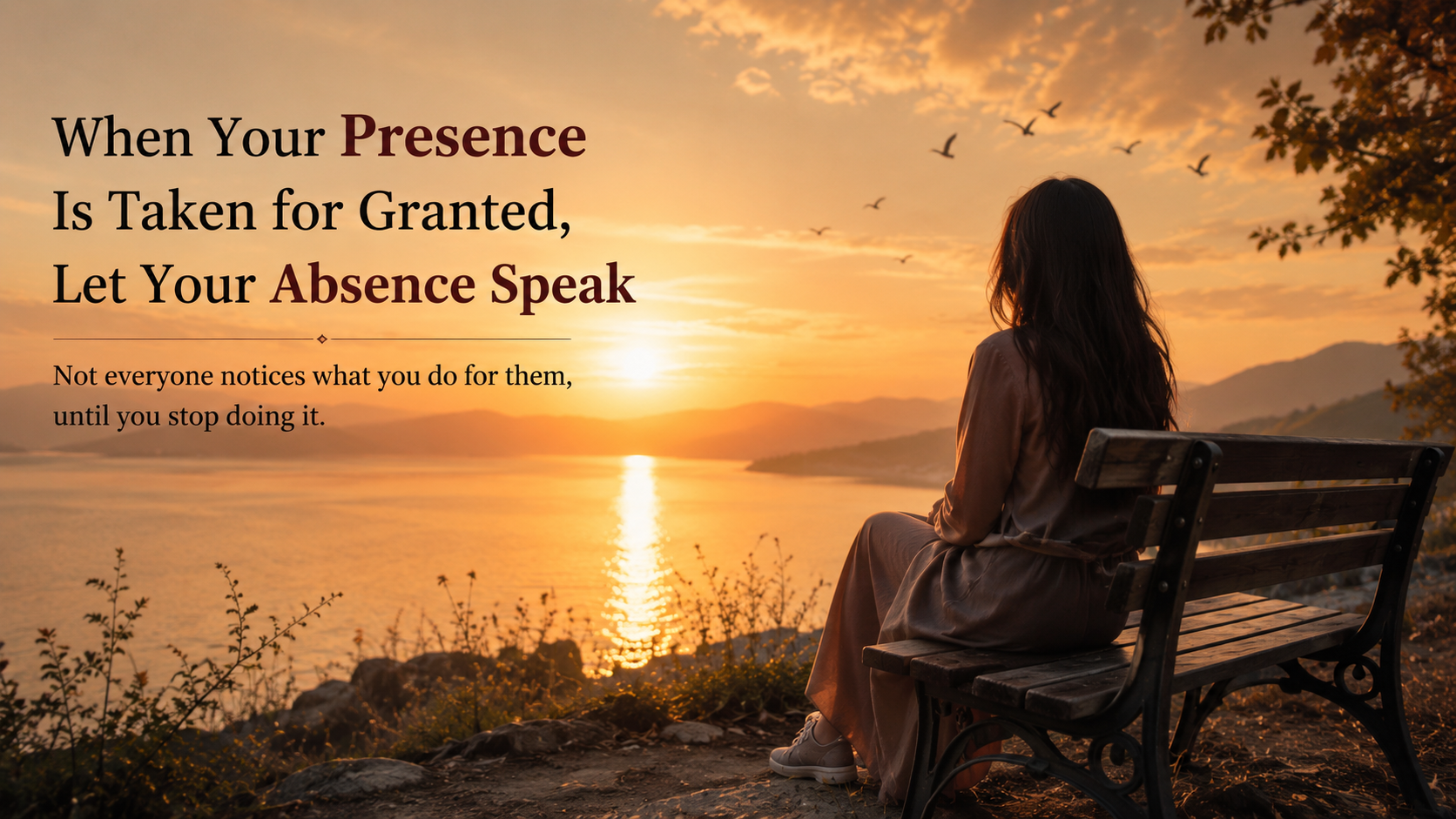
Your absence can become a language when your presence has been misunderstood.
But let that absence come from self-respect, not hatred. Let it be clean. Let it be calm. Let it be a return to yourself rather than a performance for others. Do not disappear to make people suffer. Step back because you are tired of suffering silently. Do not withdraw to manipulate. Withdraw because your heart deserves repair. Do not become cruel because others were careless. Become wise because you have finally learned the cost of giving yourself away.
There will always be people who only understand value after loss. That is unfortunate, but it is not your responsibility to keep shrinking so they never feel the emptiness created by their own neglect. You are allowed to stop proving your goodness to people who have built a habit of overlooking it. You are allowed to stop explaining your pain to people committed to misunderstanding it. You are allowed to let distance do what your words could not.
In the end, the lesson is not that you should stop loving. The lesson is that love should include you too.
Be kind, but do not become invisible. Be loyal, but do not become trapped. Be generous, but do not become empty. Give beautifully, but also know when to close your hands and protect what remains. Because the right people will not need your absence to value you, and the wrong people may never value you even after you leave.
Still, leave when staying keeps breaking you.
Sometimes the most powerful thing you can offer is not another explanation, another chance, another sacrifice, or another piece of your tired heart. Sometimes the most powerful thing you can offer is space. Space for them to understand. Space for you to heal. Space for truth to stand without your constant effort holding it upright.
And when you finally choose yourself, you may discover that absence is not emptiness at all. It is the room where your self-worth begins to breathe again.