





A story about an ordinary visit, a difficult sentence, and the people we assume will always be there to hear it
On the morning Daniel found his father’s old lunch tin, he had gone into the garage looking for a screwdriver. The tin sat on a high shelf behind a box of Christmas decorations, its blue paint scratched down to the metal along one edge. He recognised it immediately, although he had not seen it since childhood. His father had carried it to the railway depot for nearly thirty years, bringing home engine oil on his jacket and, on Fridays, a saved biscuit.
Daniel took the tin down and opened it. Inside were three bent screws, a faded train ticket, and a folded sheet of paper covered in measurements for the kitchen shelves his father had built when Daniel was twelve. The handwriting was familiar, all straight lines and numbers pressed hard into the page, and Daniel pictured him at the kitchen table, a pencil behind his ear.
His phone rang before he could look through the rest. It was his sister, Nisha, reminding him that their father was expecting him for lunch on Sunday.
“I know,” Daniel said, setting the tin beside the toolbox. “I’ll be there.”
“You said that last month.”
“Last month the children were ill.”
“They were ill the month before that as well?”
He laughed because he had no good answer, and Nisha let the silence sit between them until he promised again. Their father lived forty minutes away, in the same terraced house where they had grown up, yet Daniel had become skilled at turning a short drive into an undertaking that required a clear diary and a reason. There were children’s plans, invoices, and repairs at home. Their father never complained when Daniel cancelled, which made cancelling easier than it should have been.
On Sunday he arrived with a bag of oranges and the lunch tin on the passenger seat. His father opened the door wearing a jumper Daniel had given him five birthdays earlier, its cuffs stretched out of shape. He looked at the oranges, then past Daniel towards the car.
“Did you bring the drill?” he asked.
“Good to see you too, Dad.”
“The cupboard hinge is loose again.”
Daniel had brought the drill. They had barely taken off their coats before his father led him into the kitchen and pointed at the offending cupboard. While Daniel tightened the screws, his father stood beside him offering advice that arrived a few seconds after it was needed. It was the way they had always worked together, close enough to brush shoulders, both concentrating hard on the hinge so that neither had to consider what else they might say.
Lunch was vegetable curry reheated from the previous evening, served with rice and the pickle his father bought from a particular shop across town. Daniel ate two helpings. His father asked about the children, listened to a story about his granddaughter’s school play, and suggested she should be given a proper speaking part next time. When Daniel mentioned that work had been difficult, his father advised him to arrive earlier in the morning. Daniel began to explain why that would solve nothing, then decided the curry did not deserve an argument over it.
After lunch they sat in the back garden. The apple tree Daniel had helped plant as a boy leaned over the fence, its branches held up by a wooden post. His father told him the neighbour had been complaining about the fruit falling on her side. Daniel offered to prune it in the autumn, and his father said the neighbour could learn to appreciate free apples.
Daniel reached for a familiar joke, but his father’s hands caught his attention. The skin across the knuckles had grown thin, and one finger trembled slightly as he lifted his cup. Daniel knew his father was seventy-four. He knew about the tablets and his bad knee. Somehow those facts had remained separate from the man sitting beside him, as though age were an inconvenience his father would eventually repair with a wrench and a few impatient instructions.
He thought about saying something then. He could thank him for the shelves, the early lifts to football practice, and the years of work that had paid for school shoes without anyone describing those purchases as sacrifices. He could say that he loved him, a sentence he said freely to his children every night and had not spoken to his father since he could remember. Instead, he asked whether the neighbour had taken any of the apples.
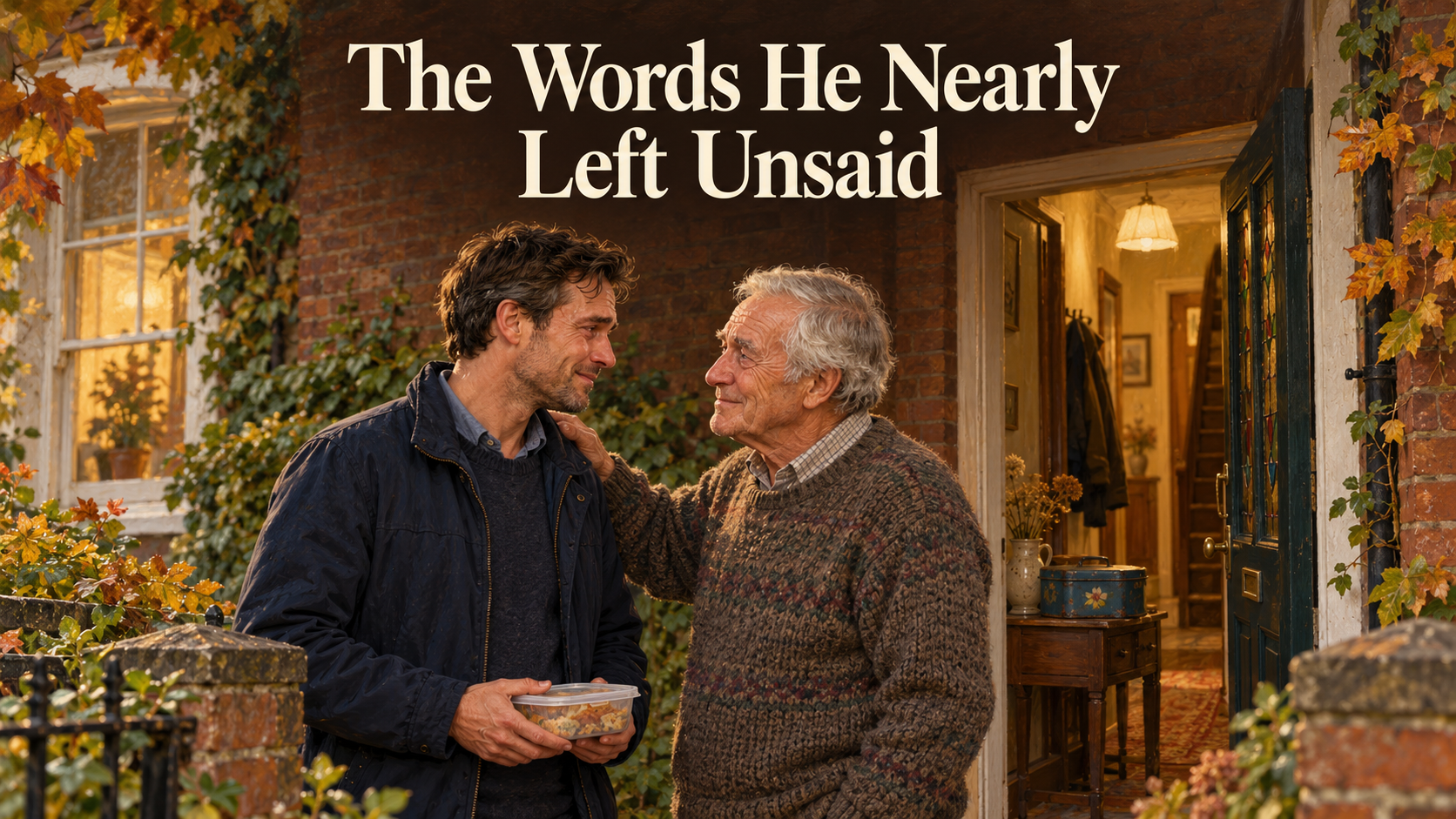
By four o’clock Daniel was putting his jacket on. His father followed him to the front door and handed him a plastic container filled with leftover curry.
“Give some to the children,” he said. “Though they’ll probably complain it’s too spicy.”
“They’ll eat it.”
“Drive carefully. There’s roadworks by the bridge.”
Daniel stepped onto the path, feeling the weight of the container in one hand and his car keys in the other. Behind him his father was already reaching for the door, and Daniel understood that if he walked to the car, the afternoon would settle into the usual pattern. He would call in a week or two, perhaps visit when the apple tree needed pruning, and the words he had been thinking about would remain available for another occasion that might be easier.
“Dad,” he said, turning back. “I found your old lunch tin.”
His father stopped. “The blue one? I thought that had gone years ago.”
“It was in our garage. I brought it, but I’ve left it in the car.”
“Keep it if you want. I don’t need a lunch tin anymore.”
Daniel nodded, then stayed where he was. His father looked at him with the concerned expression he usually reserved for a strange noise coming from the boiler.
“Those shelves you made for our kitchen,” Daniel began. “I found the measurements inside. I remember you coming home exhausted and working on them after dinner because I needed somewhere to put my books.”
“They weren’t difficult to make.”
“Maybe not for you.” Daniel shifted the container to his other hand. “I never told you how much I appreciated that sort of thing. There was a lot of it, and I noticed more than I knew how to say when I was young.”
His father glanced towards the street, where a boy was trying to persuade a reluctant dog to keep walking. Daniel almost let the conversation end there. Neither had learned how to speak through the discomfort.
“I love you, Dad,” Daniel said. “I’m glad you’re here.”
His father held the doorframe with one hand. For several seconds he studied Daniel’s face as if he had misheard him, then looked down at the curry container.
“You should get that into the fridge when you get home,” he said.
Daniel felt a brief sting of foolishness, followed by the more familiar impulse to turn the whole thing into a joke. Before he could, his father reached out and squeezed his shoulder. It was a small, firm gesture, the sort he might have given Daniel after a disappointing football match, and his hand remained there longer than it needed to.
“I love you too, son,” he said. “You know that, don’t you?”
Daniel realised that he did know. He had known in a hundred practical ways, from the extra biscuit in the tin to the curry warming on the stove when he arrived, but hearing it gave those memories somewhere to gather.
He drove home through the roadworks by the bridge, stopping once at a red light long enough to call Nisha. She answered with a distracted greeting and told him she was in the middle of making dinner. He asked whether she remembered the blue lunch tin, and she laughed about the year she had painted a crooked flower on its lid for Father’s Day. Daniel had forgotten the flower. Their father had continued taking the tin to work even after the paint began to peel.
“I told him I love him,” Daniel said.
There was a pause, then the sound of a drawer closing at her end of the call.
“How did that go?”
“He reminded me to refrigerate the curry.”
Nisha laughed again, and this time Daniel heard the affection beneath it. She told him she was coming over the following weekend to help their father with his accounts, although she suspected he had finished them already and simply wanted company. Before they hung up, Daniel thanked her for making the visits she never mentioned unless he asked. She tried to dismiss it, so he said it again, and she accepted the thanks in a voice that sounded different from the one she had used at the start of the call.
That evening, his daughter sat at the kitchen counter while he put the curry away. She was rehearsing her lines for the school play, changing the voice of each character even though she had only been assigned two sentences. Daniel watched her gather the pages into a neat pile and remembered his father sanding the edges of the shelves so Daniel’s books would not catch on a splinter.
“Grandad thinks you deserved a bigger part,” he told her.
“Grandad hasn’t seen me act.”
“He doesn’t need to.”
She considered this, apparently satisfied, and asked if Grandad would come to the performance. Daniel said he would invite him. Then he promised to be there himself, and because his daughter had learned to ask sensible questions, she wanted to know whether that meant both performances or just one. Daniel looked at the dates on the sheet and said both.
Over the following weeks, he visited his father more often. Some visits were awkward without an errand to justify the drive. They found things to do together anyway. His father showed him how to sharpen the garden shears, Daniel helped him sort a drawer full of batteries, and they disagreed about the proper time to prune the apple tree. Once, while washing dishes, his father asked whether work had become any easier. Daniel explained what had been happening, and his father listened without offering a solution.
Nothing dramatic had happened to force Daniel’s return. His father had not fallen ill, and no frightening phone call had arrived in the night. That ordinary good fortune became more precious to Daniel as the months passed. He had said what mattered while there was still time for another lunch, another conversation, and even another disagreement about the tree. He had also learned that one honest sentence did not complete the work of loving someone; it made it easier to show up the next Sunday and say what was true there too.
In October they pruned the apple tree together. The neighbour came out to ask if they could cut the branch that hung over her washing line, and his father gave Daniel a pointed look before agreeing. Afterwards, as they gathered the fallen leaves, he told Daniel he had kept the painted lunch tin because Nisha had been so proud of her flower. He remembered that Daniel used to wait by the front window on Fridays, convinced there would be a biscuit left inside.
“There usually was,” Daniel said.
“I made sure of it.”
Daniel carried the last bundle of branches to the front gate. When he came back, his father was standing beneath the tree, checking the space they had opened between its limbs. He looked pleased with their work, though he would probably find something to correct by morning. Daniel stayed beside him for a while, thinking of all the years he had mistaken being known for having nothing left to say.
His father went inside to put the kettle on, and Daniel followed before the tea grew cold.