





Why Modern Life Feels Exhausting All the Time
There comes a stage in life when exhaustion no longer feels temporary and slowly becomes part of your everyday identity. You wake up tired even after sleeping properly. You finish one task only to immediately think about the next five waiting for your attention. Your mind keeps running long after the day is over, and somewhere in the middle of all this pressure, you begin believing that this constant stress is simply what adulthood looks like.
Modern life has normalized emotional overload in a way previous generations could never have imagined. People are expected to build successful careers, maintain healthy relationships, stay physically fit, remain emotionally balanced, keep their homes organized, respond to messages instantly, continue learning new skills, look confident, and somehow still smile through all of it. The strange thing is that nearly everyone feels overwhelmed, yet everybody pretends they are managing perfectly.
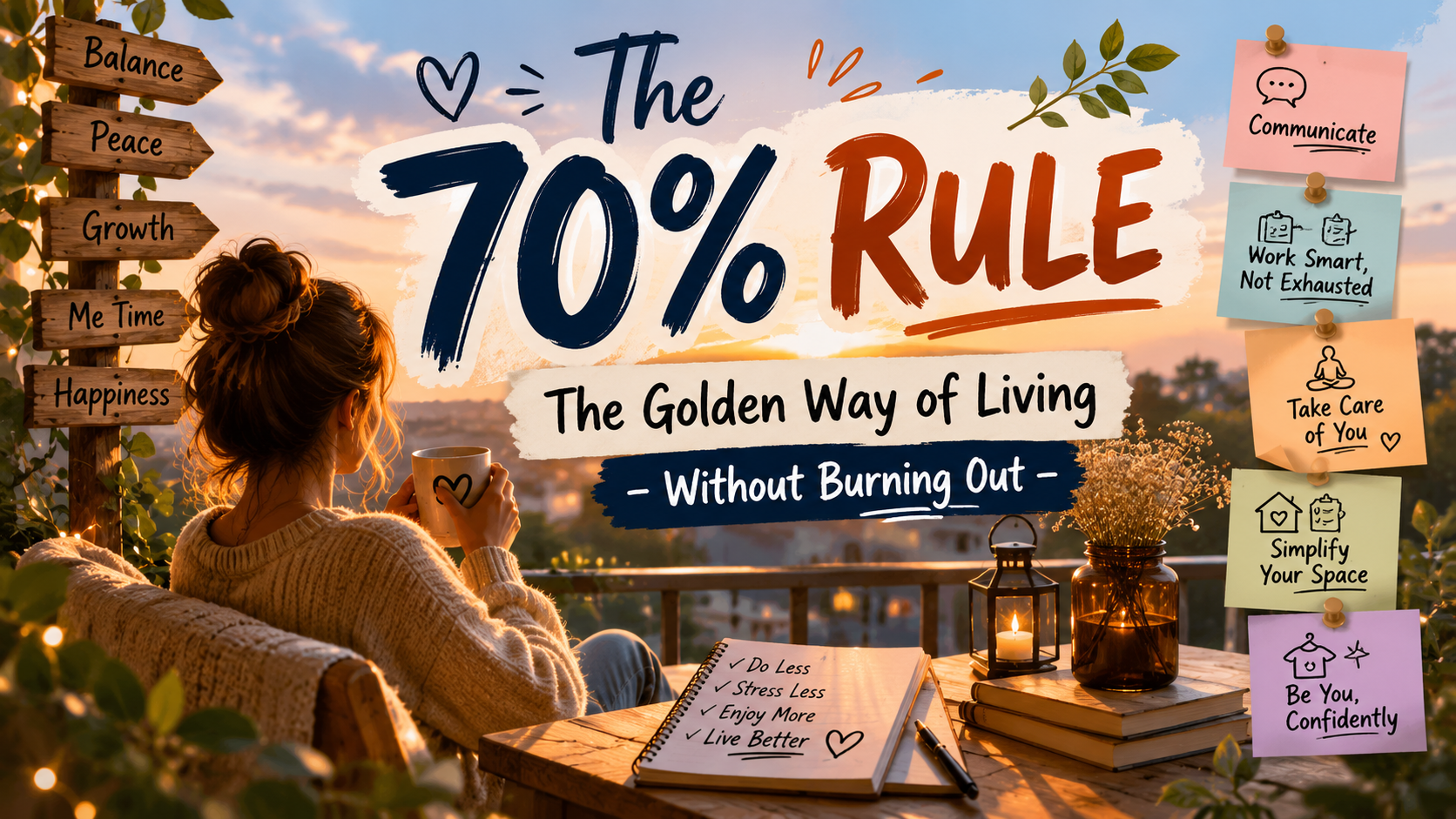
This is exactly why the 70% rule matters so much.
The idea itself is simple, but the impact can completely change the way a person experiences life. Instead of trying to perform at full intensity in every area all the time, you intentionally allow yourself to function at a sustainable pace. You stop treating every responsibility like a crisis that demands perfection. You stop believing your value depends on operating at maximum capacity every hour of the day. Most importantly, you begin understanding that consistency creates a healthier life than constant emotional overexertion.
What Is the 70% Rule?
The 70% rule is the practice of giving steady, realistic, sustainable effort instead of exhausting yourself trying to achieve perfection in every area of life simultaneously. It does not encourage laziness, carelessness, or lack of ambition. Instead, it encourages balance, emotional stability, and long-term sustainability.
Many people believe success requires constant overperformance, but that mindset quietly destroys mental peace over time. Human beings are not built to operate under nonstop pressure without consequences. Even machines require maintenance, cooling systems, updates, and rest periods. Yet people continue pushing themselves emotionally, mentally, and physically without pause, then wonder why anxiety, burnout, frustration, and emotional exhaustion eventually take control.
The 70% rule challenges the unhealthy belief that life must always be optimized.
Instead of chasing impossible perfection, it asks a far healthier question:
What if doing things reasonably well, consistently, could actually create a happier and more meaningful life?
That question sounds simple, but it unsettles many people because overworking often becomes deeply connected to self-worth. Some individuals genuinely feel valuable only when they are exhausted. They feel productive only when overwhelmed. They believe rest means falling behind while everyone else continues progressing.
But life was never meant to feel like a nonstop emergency.
The Hidden Problem With Always Trying to Give 100%
One of the biggest misconceptions about burnout is that people assume it comes only from working too hard. In reality, burnout often comes from trying to be perfect in too many areas at the same time.
People are not just working hard anymore. They are overthinking conversations, overanalyzing mistakes, constantly comparing themselves to others online, trying to impress everyone around them, and emotionally stretching themselves beyond what the human mind can realistically sustain.
The dangerous part is that society often rewards this behavior at first.
The employee who works late receives praise. The person who is always available gets recognized. The friend who never says no becomes “dependable.” Social media celebrates endless productivity so aggressively that many individuals now feel guilty simply for resting.
Somewhere along the way, exhaustion became a symbol of ambition.
But the body always keeps score.
Eventually the mind slows down. Motivation weakens. Focus becomes inconsistent. Small tasks start feeling emotionally heavy. Patience disappears faster. Even enjoyable activities begin feeling like responsibilities.
The problem is not ambition itself. The problem is trying to maintain impossible intensity forever.
The 70% rule creates a healthier approach because it values sustainability over emotional collapse.
The 70% Rule in Communication and Relationships
Modern communication has become emotionally exhausting because people spend too much time trying to sound perfect instead of simply being honest. Many individuals rehearse conversations repeatedly in their minds before speaking. They worry about sounding intelligent enough, mature enough, emotionally balanced enough, calm enough, convincing enough, and polite enough all at once.
As a result, even ordinary conversations become mentally draining.
Some people avoid difficult discussions entirely because they are terrified of being misunderstood. Others rewrite messages repeatedly trying to avoid saying the wrong thing. There are individuals who mentally replay conversations for hours afterward, analyzing every sentence they spoke.
The real issue is not communication itself. The real issue is perfectionism attached to communication.
Most meaningful human connections are not built through flawless wording. They are built through sincerity, honesty, emotional openness, and clarity.
The 70% rule teaches people to stop chasing perfect communication and start valuing authentic communication instead. You do not need a perfect explanation every time something hurts you. You do not need to prepare an emotional TED Talk before expressing a boundary. Sometimes saying something honestly and respectfully is enough.
One of the hardest lessons people eventually learn is that misunderstanding is part of life. No matter how carefully you explain yourself, some individuals will still interpret your words through their own experiences, insecurities, assumptions, or emotional state.
Trying to fully control every reaction becomes emotionally exhausting.
The 70% rule allows people to communicate clearly without carrying the impossible burden of perfect interpretation.
Work, Productivity, and the Burnout Culture
Work culture today often rewards people for sacrificing themselves. Being constantly busy has become something people proudly display. Long working hours, endless meetings, skipped meals, lack of sleep, and nonstop availability are often treated like proof of dedication.
At first, this lifestyle may even feel rewarding because effort receives recognition. Promotions happen. Praise increases. Productivity rises temporarily. The individual feels important because they are constantly needed.
But eventually the cost becomes visible.
The human brain cannot remain under pressure forever without consequences. Emotional fatigue slowly damages creativity, patience, focus, and decision-making. People begin feeling mentally detached from their own lives because their nervous system never fully relaxes.
Many professionals continue operating this way because they believe slowing down means becoming less successful. What they fail to realize is that chronic exhaustion reduces the quality of everything they do.
A tired brain makes weaker decisions.
An overwhelmed mind struggles to think creatively.
An emotionally drained person loses the ability to enjoy their own achievements.
The 70% rule creates a healthier relationship with productivity because it encourages sustainable ambition instead of emotional self-destruction.
You can still work hard. You can still pursue goals seriously. But you stop treating burnout like a badge of honor.
Ironically, people often perform better long term when they stop trying to prove themselves every second of the day. A rested mind thinks more clearly. Emotional resilience improves. Communication improves. Problem-solving improves.
A person functioning steadily at 70% for years often accomplishes far more than someone repeatedly pushing themselves to emotional collapse.
Why Self-Care Does Not Need to Be Complicated
Social media has complicated self-care so much that many people now treat wellness like another impossible standard. Suddenly self-care involves expensive products, highly aesthetic routines, perfectly organized mornings, luxury vacations, and endless pressure to optimize every part of life.
Real self-care rarely looks glamorous.
Sometimes self-care simply means sleeping properly after weeks of exhaustion. Sometimes it means drinking enough water after forgetting all day. Sometimes it means taking a short walk because your mind feels overcrowded. Sometimes it means staying offline for a while because your brain is overstimulated.
The healthiest habits are usually deeply ordinary.
That is why the 70% rule works so well in everyday life. Instead of building unrealistic routines that collapse after three days, people begin creating manageable habits that genuinely support emotional and mental health over time.
Small actions repeated consistently create powerful long-term results.
A little extra sleep matters.
A daily walk matters.
Taking breaks matters.
Eating properly matters.
Spending time away from screens matters.
People underestimate how strongly the nervous system responds to consistency.
The goal of self-care is not to create a perfect lifestyle. The goal is to create a life that feels emotionally sustainable.
Cleaning, Organizing, and the Pressure of Perfection
Many people secretly feel embarrassed when their homes do not resemble the carefully curated spaces constantly shown online. Social media has created unrealistic expectations around domestic perfection. Every room appears spotless. Every shelf looks beautifully arranged. Every corner feels professionally designed.
Real life does not work like that.
Real homes contain unfolded laundry, unfinished tasks, messy tables, random clutter, and signs that actual human beings live there. The problem begins when people start believing their home must look perfect at all times to be acceptable.
That pressure slowly transforms the home into another source of stress instead of comfort.
The 70% rule changes the purpose of organization completely. Instead of cleaning for perfection or external validation, people begin cleaning for peace, functionality, and emotional comfort.
A peaceful home does not need magazine-level perfection.
It needs warmth.
It needs comfort.
It needs enough structure that your mind can breathe instead of constantly feeling overwhelmed.
There is emotional freedom in accepting that “clean enough” is often genuinely enough.
Style, Confidence, and Feeling Comfortable in Your Own Life
Many individuals spend years trying to look impressive instead of trying to feel comfortable in themselves. They compare their appearance constantly to edited photos, unrealistic beauty standards, curated online lifestyles, and endless trends.
The pressure becomes emotionally exhausting because expectations never stop changing.
The 70% rule creates space for authenticity.
Instead of dressing for constant approval, people begin focusing on comfort, confidence, practicality, and emotional ease. Real confidence rarely comes from looking flawless every day. Real confidence usually develops when a person feels emotionally safe being themselves without constantly performing for others.
Wearing clean comfortable clothes, maintaining self-respect, and feeling aligned with your own identity matter far more than endlessly trying to impress everyone around you.
Confidence becomes healthier when it stops depending entirely on external validation.
The Real Meaning of a Balanced Life
One of the most beautiful things about the 70% rule is that it allows people to remain ambitious without becoming emotionally consumed by ambition. You can still pursue growth, success, achievement, learning, and meaningful goals. But you stop sacrificing your peace of mind in the process.
That shift changes everything.
Because eventually most people realize that constant pressure does not automatically create happiness. Endless productivity does not guarantee fulfillment. Perfect performance does not always create peace.
There is no reward waiting at the end of life for the person who exhausted themselves trying to maintain impossible standards forever.
Life becomes healthier when people finally accept that sustainability matters more than perfection. Some days will feel productive. Some days will feel emotionally heavy. Some weeks will feel balanced. Other weeks will feel chaotic.
That inconsistency is part of being human.
The goal is not to become perfect.
The goal is to remain emotionally healthy enough to continue living, loving, growing, working, and experiencing life without constantly collapsing under the pressure of unrealistic expectations.
That is the deeper wisdom behind the 70% rule.
It teaches people that peace is not found in doing everything flawlessly. Peace is often found in finally realizing that being human was never supposed to require perfection in the first place.