



Confidence Is Not About Being Sure Everything Will Work Out
For a long time, many of us grow up with a slightly misleading idea of what confidence looks like, because we tend to notice the people who speak without hesitation, take decisions quickly, walk into unfamiliar rooms without appearing uncomfortable, or seem completely certain about what they are doing.
From a distance it becomes easy to assume that confidence means having no fear, no self-doubt and no uncomfortable thoughts running through your mind before something important happens.
The problem with that definition is that it sets an impossible standard, because almost everyone experiences uncertainty, including the people who appear composed from the outside.
The difference is rarely that confident people never worry about failure, rejection, embarrassment or disappointment, but rather that they have gradually learned not to treat those possibilities as reasons to remain stuck.
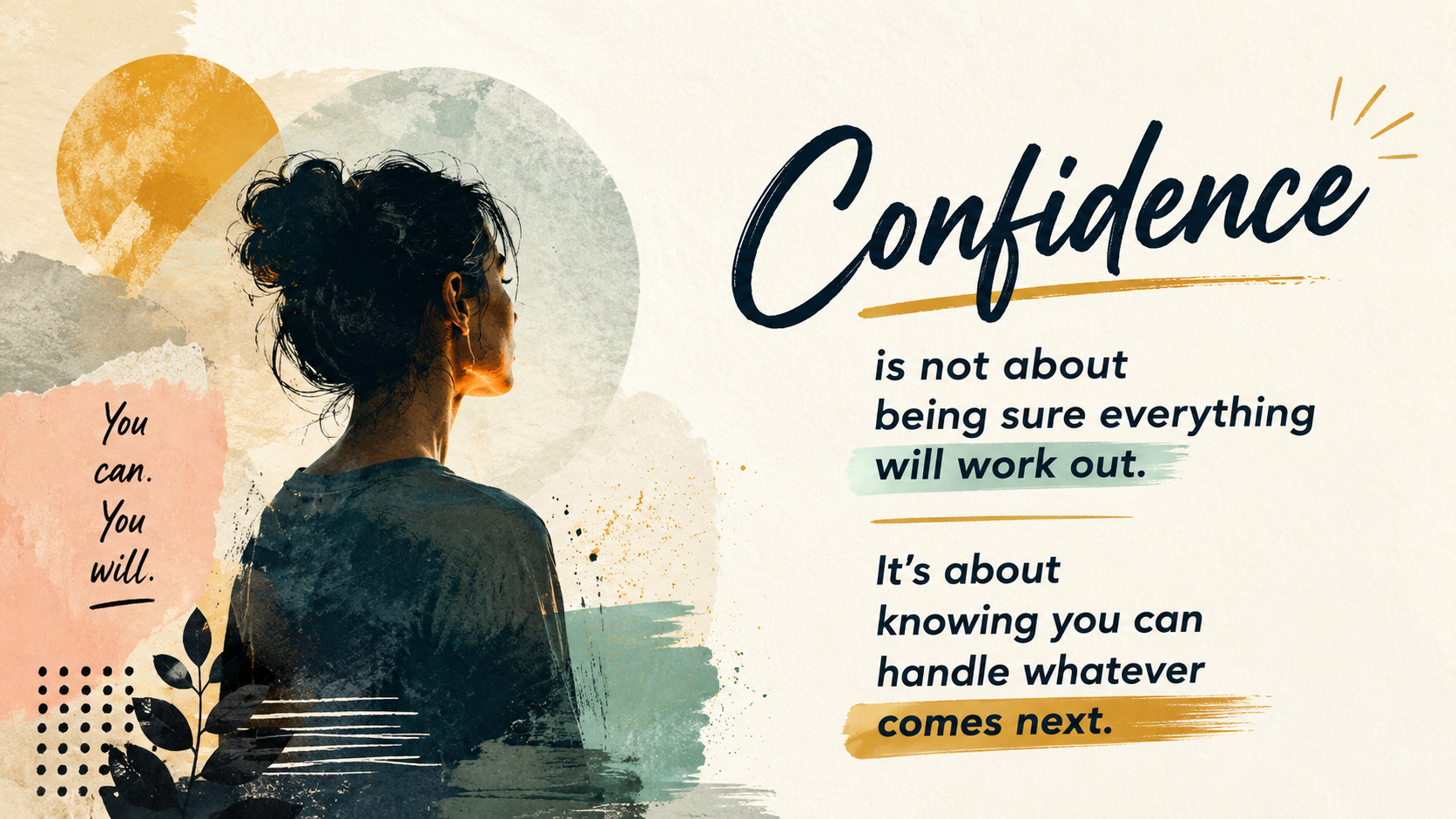
Real confidence is not the belief that everything will go according to plan, because life does not offer that kind of guarantee no matter how intelligent, experienced, disciplined or prepared we become, and the sooner we understand this, the easier it becomes to stop chasing a version of confidence that depends on controlling outcomes we were never fully able to control in the first place.
Confidence becomes much more useful when we see it as the ability to say, in our own way, that we will prepare properly, make the best decision we can with the information available, accept that something may still go wrong, and trust ourselves enough to deal with the consequences if it does.
That may sound less glamorous than the usual idea of fearless confidence, but in real life it is far more powerful.
We Spend Too Much of Life Waiting to Feel Completely Ready
Think about how many things people postpone because they are waiting for a feeling that rarely arrives.
Someone wants to apply for a better role but keeps reading the job description and focusing on the two requirements they do not have, even though they meet almost everything else and could probably learn the remaining parts quickly once they are in the role.
Someone else wants to start a business but spends months adjusting the idea, researching competitors, changing the website, refining the brand, reconsidering the pricing and telling themselves that they will launch once everything feels properly settled, even though the only thing that would really teach them whether the idea works is putting it in front of actual customers.
Another person has something useful to say in a meeting but remains silent because they are worried that somebody might challenge their point, and by the time they have mentally perfected the answer, the conversation has already moved on.
These situations look different, but underneath them there is often the same expectation, which is that we should feel fully prepared before taking a meaningful step.
Unfortunately, readiness does not always arrive before action, because in many areas of life we become ready by doing the thing itself.
You can prepare for a difficult presentation, but you learn how to handle difficult presentations by giving them.
You can read about leadership, but you learn leadership when people depend on your decisions and you discover that sometimes there is no perfect option available.
You can study entrepreneurship for years, but eventually you still have to ask somebody to pay for what you are offering.
You can think about setting boundaries, but sooner or later you have to say the uncomfortable sentence and allow another person to react however they choose to react.
This is one of the reasons confidence often comes after action rather than before it, because confidence grows when we collect evidence that we can enter uncertain situations and still find our way through them.
Perfection Feels Safe, but It Often Becomes Another Form of Fear
Perfection can look like ambition from the outside, and sometimes it genuinely is, because wanting to do good work, checking the details, preparing carefully and holding yourself to a high standard can be extremely valuable qualities.
However, perfectionism becomes something very different when the real objective is no longer producing excellent work but protecting yourself from criticism, mistakes or embarrassment.
At that point, preparation slowly turns into avoidance.
You revise the presentation one more time because you are afraid somebody will ask a question you cannot answer.
You keep rewriting the proposal because you do not want anyone to find a weakness in your thinking.
You delay publishing the article because you imagine someone noticing a flaw.
You continue researching a decision because choosing one option means accepting that another option might have been better.
The difficulty is that no amount of preparation can remove every possible problem, because people behave unpredictably, markets change, technology fails, circumstances shift, information remains incomplete and sometimes events simply do not unfold the way we expected.
When we depend on perfection before we allow ourselves to act, we are asking the world to give us something it cannot provide, which is certainty.
Confidence asks for something more realistic.
It asks whether we have prepared enough to take the next sensible step and whether we trust ourselves to adjust if new information appears.
That is a healthier standard because it recognises that good judgment is not about predicting everything correctly in advance, but also about responding intelligently when reality changes.
The Most Confident Person Is Not Always the Most Optimistic Person
There is a strange idea that confidence requires us to expect the best outcome, which is why people sometimes believe they need to tell themselves that the interview will definitely go well, the business will succeed, the relationship will work, the investment will perform or the presentation will impress everyone in the room.
Positive thinking can be useful when it encourages action, but there is a difference between hope and certainty, and pretending that negative outcomes are impossible does not necessarily make us more confident.
Imagine that you are preparing for an important interview for a role you genuinely want.
One approach would be to keep telling yourself that you are definitely going to get the job, that you are perfect for the position and that there is no reason the company would choose anyone else, because thinking about rejection feels uncomfortable and you want to enter the interview believing only in success.
Another approach would be to prepare thoroughly, understand the organisation, practise your examples, think about the questions you may be asked, enter the conversation hoping it goes extremely well, and at the same time accept that the final decision depends on factors you cannot completely control.
There may be another candidate with experience that happens to match the role more closely, the organisation may change its hiring priorities, the salary expectations may not align, or the interviewers may simply feel that somebody else fits the team better.
If that happens, it will probably be disappointing, particularly if you invested time and emotional energy in the opportunity, but it does not mean your career is finished or that you were foolish to try.
You can ask for feedback, review your answers, understand what you could improve, continue applying and carry the experience into the next interview.
That is confidence grounded in reality, because your belief in yourself does not disappear simply because one particular outcome does not go your way.
Confidence Is Built Through Evidence, Not Through Pretending
There are many techniques people use to improve confidence, including affirmations, visualisation, positive self-talk and motivational content, and some of these can genuinely help by changing the way we approach difficult situations.
However, the strongest confidence usually comes from something much less exciting, which is accumulated evidence.
You become more confident speaking in front of people after you have done it several times and discovered that even when you stumble over a sentence, forget a point or receive a difficult question, the world does not collapse around you.
You become more confident handling conflict after you have survived uncomfortable conversations and realised that disagreement does not automatically mean the end of a relationship.
You become more confident in your professional judgment after you have made difficult decisions, seen some succeed, seen others fail, corrected mistakes and learned to recognise patterns that were invisible to you earlier in your career.
You become more confident about rebuilding your life after experiencing something that forced you to rebuild it once before.
The important part is that these experiences do not need to end perfectly in order to strengthen you.
Sometimes the confidence comes precisely because things did not go perfectly and you still managed to cope.
You made the wrong choice and corrected it.
You trusted the wrong person and eventually recognised it.
You accepted a job that did not work out and found another one.
You lost money on an idea and became more careful the next time.
You gave a poor presentation, felt embarrassed for a few days, learned what went wrong and became a much stronger communicator later.
Confidence grows when your past begins reminding you that discomfort, mistakes and uncertainty are survivable.
The Ability to Adapt Is More Valuable Than the Ability to Predict
We often admire people who appear to know what is going to happen, particularly in business and professional life, where certainty is sometimes mistaken for expertise.
Yet anyone who has worked long enough on complex projects, led teams, built organisations, raised children, managed finances or simply lived through enough unexpected situations knows that prediction has limits.
The more complicated a situation becomes, the more likely it is that something will happen that nobody planned for.
A key employee leaves at the worst possible time, a supplier misses a deadline, a customer changes their requirements halfway through delivery, a budget gets reduced, a piece of technology does not perform as expected, or a decision that looked completely reasonable based on the available information turns out differently because circumstances changed.
Confidence in these situations does not mean insisting that the original plan was correct.
It means being willing to look at what has changed and decide what needs to happen next.
Some people struggle because changing the plan feels like admitting failure, whereas experienced and confident people usually understand that adapting is not weakness but part of responsible decision-making.
There is nothing particularly impressive about following a plan that no longer makes sense simply because you were the person who created it.
There is far more strength in saying that the assumptions have changed, the evidence now points in another direction and the sensible thing is to adjust.
Sometimes the Most Confident Answer Is “I Don’t Know”
This becomes especially important as responsibilities increase, because many people assume that becoming more senior means having more answers.
Experience certainly gives us more knowledge, but it also teaches us how much there is that no individual person can possibly know.
That is why one of the clearest signs of professional maturity is becoming comfortable with sentences such as, “I don’t know yet, but I know how we can find out,” or, “I need more information before I can give you a reliable answer.”
There is a large difference between uncertainty and incompetence.
Pretending to know something because we are afraid of looking inexperienced may protect our ego for a few minutes, but it can create far bigger problems later when people discover that the answer was unreliable.
Someone who is genuinely confident does not need to perform intelligence every minute of the day.
They can ask questions.
They can change their mind when better evidence appears.
They can admit that somebody else understands a subject better than they do.
They can bring the right people into a conversation instead of trying to prove that they personally have every answer.
This kind of confidence is often less noticeable than the loud version, but it tends to build much stronger trust over time because people know they are dealing with someone who values getting the answer right more than appearing right.
Preparing for the Worst Is Different From Expecting the Worst
There is also a useful distinction between confidence and constant pessimism, because thinking through negative outcomes does not mean we should spend our lives imagining disasters.
Healthy preparation looks at a risk and asks what we would realistically do if it happened.
If you are considering leaving a secure job to start a business, confidence does not require you to believe that the business cannot fail, and it also does not require you to spend every night worrying that you will lose everything.
A more useful approach would be to understand your financial position, decide how much money you are prepared to invest, work out how long you could manage without stable income, create a point at which you would reconsider the plan, and think about what you would do if the business did not develop as expected.
Once you have thought through those questions, the risk becomes more understandable.
The same approach can be applied to many areas of life.
Before a difficult conversation, you can consider how the other person might respond and how you want to respond in return.
Before accepting a new role, you can think about what you would do if the organisation turns out to be different from what you expected.
Before making a large financial decision, you can consider whether the downside is something you could realistically absorb.
The purpose of thinking about the worst is not to frighten yourself away from living, but to stop uncertainty from becoming an undefined monster in your imagination.
A problem becomes easier to face when you can see the possible responses available to you.
Confidence Often Grows Through Very Ordinary Moments
We sometimes imagine that confidence arrives after a major achievement, but most of it develops through moments that nobody else will remember.
You disagree with someone respectfully instead of nodding simply to avoid tension.
You ask a question in a room full of people who seem more experienced.
You admit that you made a mistake rather than spending energy trying to hide it.
You send the application even though you are unsure whether you are good enough.
You share an idea before you have polished every possible detail.
You negotiate instead of automatically accepting what has been offered.
You say no to something that does not work for you even though you worry about disappointing someone.
You attend an event where you know nobody and manage to have a few conversations despite feeling uncomfortable at the beginning.
None of these moments needs to become a dramatic turning point, because the value comes from the repeated message they send to your mind, which is that discomfort can be experienced without controlling every decision you make.
Over time, you stop asking whether you feel completely comfortable and start asking whether something is worth doing despite the discomfort.
That is a much more useful way to move through life.
Failure Becomes Easier to Handle When We Stop Turning It Into Identity
One of the biggest obstacles to confidence is the tendency to convert an event into a definition of who we are.
A project failed, so we tell ourselves that we are bad at our job.
Someone rejected us, so we decide that we are not valuable enough.
A business idea did not work, so we conclude that we are not capable of building anything.
We made a poor decision, so we begin questioning every decision that follows.
This way of thinking makes failure much heavier than it needs to be because it turns temporary evidence into a permanent judgment.
A failed project is information about a particular project, involving specific people, circumstances, assumptions and decisions.
A rejection is one decision made in one context.
A mistake is something that happened, not an identity we have to carry permanently.
When we become better at separating ourselves from individual outcomes, we also become better at learning from them because we no longer need to defend our entire sense of worth.
We can look directly at what happened and ask whether we prepared properly, whether we missed something, whether the timing was wrong, whether our assumptions were unrealistic or whether the result simply involved factors outside our control.
That is when failure becomes useful instead of merely painful.
Confidence Changes the Way We Deal With People
Confidence also affects relationships in ways that are easy to overlook.
People who do not trust their ability to deal with uncomfortable outcomes sometimes remain in situations they dislike because they are more afraid of what might happen if they speak honestly.
They agree when they want to say no.
They tolerate behaviour that repeatedly crosses their boundaries.
They avoid difficult conversations because they fear conflict.
They continue trying to keep everyone happy because someone else’s disappointment feels unbearable.
Greater confidence does not mean becoming insensitive or refusing to compromise, because healthy relationships require patience, generosity and the willingness to understand another person’s point of view.
What changes is the belief that you must sacrifice yourself in order to avoid every uncomfortable reaction.
You begin to understand that another person can disagree with you and you can still be okay.
Someone can be disappointed by your decision and you can still care about them.
A difficult conversation can create tension without destroying the relationship.
A relationship can even end, and although the emotional consequences may be painful, your life can still continue and eventually take another shape.
When you trust yourself to survive difficult emotions, you become less likely to make major decisions purely to avoid them.
You Do Not Need to Become Fearless
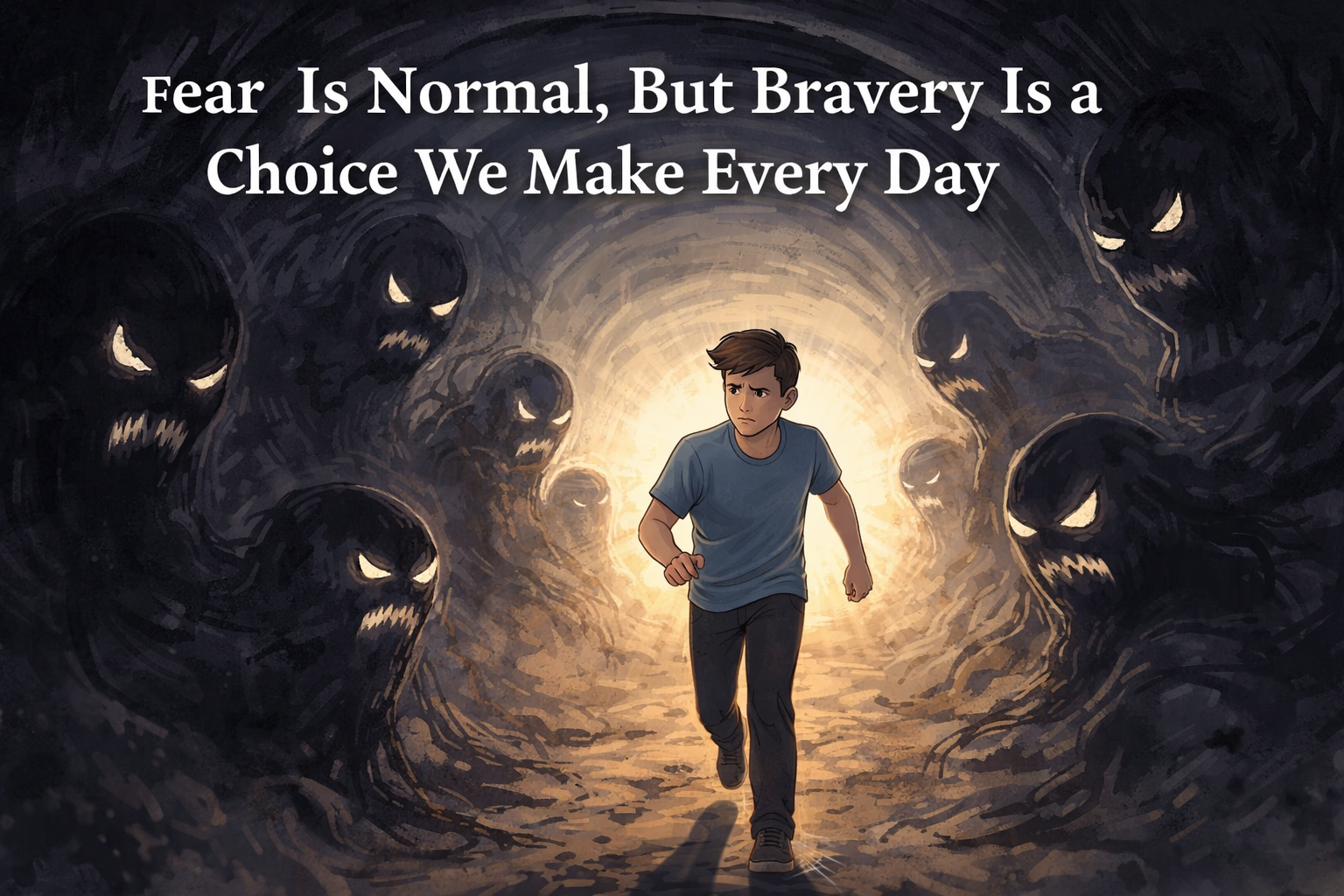
Perhaps one of the most useful things we can understand about confidence is that fear does not have to disappear before we move forward.
There are situations in which even experienced people feel nervous.
An executive who has delivered hundreds of presentations may still feel tension before addressing a large audience.
A leader who has made difficult decisions for years may still lose sleep before telling people that their roles are changing.
A parent may still worry about whether they are making the right choice for their child.
Someone beginning again after a major life change may still wonder whether they have the energy to rebuild.
Confidence does not necessarily remove any of those feelings.
It simply changes their authority.
Nervousness can come with you into the room without deciding whether you speak.
Fear can sit beside you while you make the decision without making the decision for you.
Uncertainty can remain part of the situation without becoming a reason to avoid it.
Once we stop demanding fearlessness from ourselves, confidence becomes much more achievable.
A Better Question to Ask Yourself
When you are facing something important and your mind begins listing everything that could go wrong, there is a simple change of question that can make a surprising difference.
Instead of repeatedly asking, “What if this does not work?”, try asking, “If this does not work, what would I actually do next?”
The first question often creates anxiety because it leaves you staring at the possibility of failure.
The second question creates options.
Perhaps you would try again with a different approach.
Perhaps you would ask somebody experienced for advice.
Perhaps you would accept that the opportunity was not right and move toward another one.
Perhaps you would need to rebuild something gradually.
Perhaps you would have to admit that you were wrong, apologise and repair the damage.
Perhaps the outcome would hurt for a while and you would simply give yourself time before deciding what comes next.
None of these answers makes disappointment pleasant, but they remind you that most disappointing outcomes are not the end of your story.
There is usually another decision available after the one that did not work.
Confidence Is Trusting Yourself, Not Trusting the Future
We cannot build a life in which nothing goes wrong, and trying to create one will probably leave us more anxious rather than less, because we will spend enormous amounts of energy attempting to control variables that were never completely ours to control.
What we can build is greater trust in our ability to respond.
We can become better at asking for help.
We can learn to recover from mistakes.
We can develop financial buffers, stronger skills, healthier relationships and better judgment.
We can learn when to persist and when to change direction.
We can become more comfortable saying that we do not know.
We can stop seeing every rejection as a verdict and every failure as permanent.
Most importantly, we can stop waiting for the day when we finally become a person who never doubts themselves, because that person may not exist.
The confidence worth building is not the confidence that promises us a perfect outcome.
It is the confidence that allows us to walk toward something meaningful while knowing that the outcome remains uncertain.
You prepare carefully because preparation matters, you hope for the best because hope gives us energy, and you still leave room for the possibility that life may give you something different from what you expected.
When that happens, you may be disappointed, frustrated or frightened, and you may need some time before you know exactly what to do, but you can still trust that another step will eventually become visible.
That is what makes confidence stronger than perfection, because perfection depends on everything going right, while confidence allows you to keep going even when it does not.