






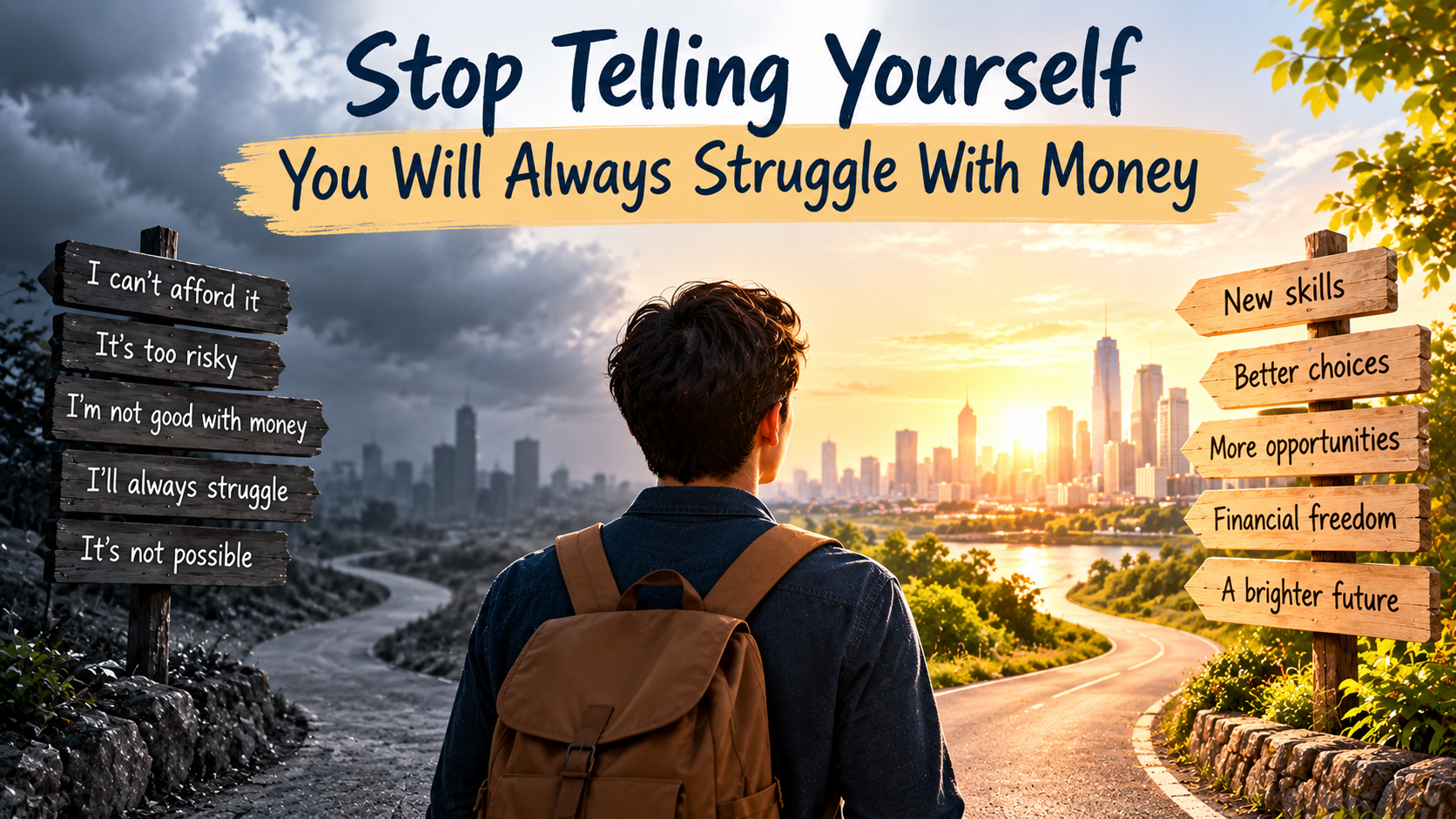
The way we think about money can shape our choices long before it changes our bank balance
Most people do not wake up one morning and consciously decide that they will never become financially comfortable.
The belief usually develops much more slowly, through years of small experiences, family conversations, disappointments, missed opportunities and things we repeatedly tell ourselves when life does not go according to plan.
Perhaps you grew up hearing that money was always difficult to earn.
Maybe your parents worked incredibly hard and still worried about bills at the end of every month.
Perhaps you tried starting a business and lost money, or you watched someone close to you take a financial risk that ended badly.
Experiences like these stay with us, and over time they can become something more powerful than memories because they begin influencing what we expect from our own future.
Without noticing it, we start creating rules for ourselves.
A secure salary is safer than trying something new. Investing is something wealthy people do. Starting a business is too risky. Asking for a higher salary might make us look greedy. Buying a home is impossible now. Financial freedom belongs to people who were born into better circumstances.
Eventually, we stop questioning these ideas because they no longer feel like opinions. They feel like facts.
That is where changing your financial life sometimes has to begin.
Not with pretending you are rich when you are not, and certainly not with believing that money will somehow arrive because you have learned how to think positively. It begins by looking at the beliefs you have carried for years and asking a much more uncomfortable question:
Are these beliefs describing my circumstances, or are they deciding my future?
We often turn temporary situations into permanent identities
There is a big difference between saying, “I am struggling financially at the moment” and saying, “I am terrible with money.”
The first statement describes a situation that can potentially change, while the second turns that situation into a description of who you are.
People do this in many areas of life without realising it. Someone who goes through a difficult relationship begins believing they are unlucky in love. Someone who fails an exam decides they are not intelligent. Someone whose first business closes decides they were never meant to be an entrepreneur.
Money works in exactly the same way.
A few poor decisions can become “I have always been bad with money.” A period of unemployment can become “I never get good opportunities.” Watching friends progress faster can become “Everyone else knows something I don’t.”
Once these statements become part of your identity, they can influence your decisions in surprisingly practical ways.
If you genuinely believe you will never earn significantly more money, why would you spend six months learning a difficult new skill?
If you believe businesses are only successful because of luck or connections, why would you seriously explore starting one?
If you believe investing is only for wealthy people, you may never learn how investing actually works, even when your income eventually gives you the opportunity.
The belief begins influencing the behaviour, and the behaviour eventually produces evidence that appears to confirm the belief.
That cycle can continue for years.
Being realistic does not mean expecting the worst
There is a strange idea that pessimism is somehow more intelligent than optimism.
If someone says, “I probably cannot do that,” we often consider them realistic. If another person says, “I don’t know how to do it yet, but I think I can learn,” we sometimes consider them overly optimistic.
Yet neither person actually knows what will happen.
The second person has simply left the future open.
That distinction matters because there is nothing financially responsible about convincing yourself that improvement is impossible. You should absolutely know how much debt you have, how much you spend, what your salary is and whether your finances are moving in the right direction. Ignoring difficult numbers does not create wealth.
But once you understand your current position, repeatedly worrying about it does not improve those numbers either.
Suppose someone has £15,000 of debt. They need to accept that reality and build a serious plan for dealing with it, but they do not need to spend every evening telling themselves that they have ruined their life. Those are two completely different things.
One is financial awareness.
The other is a story about the future.
And stories about the future have a strange habit of affecting what we do in the present.
The questions you ask yourself can change what you notice
Imagine two people working in similar jobs and earning similar salaries.
The first regularly thinks, “Everything is becoming expensive and my salary will never be enough.”
The second thinks, “My salary is not growing fast enough, so what could I realistically do over the next two years to increase my income?”
Both people may be looking at exactly the same economic reality, but their minds have been given completely different problems to solve.
The first question encourages frustration because there is nowhere for the thought to go. The second encourages investigation because there are possible answers.
Perhaps the person discovers that people with a particular certification earn considerably more. Perhaps they find opportunities in another company, industry or country. They might realise that their existing knowledge could be used for consulting, teaching, freelancing or creating a small product. They might even discover that the higher income they were chasing would not improve their life enough to justify the additional stress.
None of these outcomes are guaranteed, but the question creates movement.
This is one of the most practical ways to change your thinking about wealth. Instead of forcing yourself to believe something that feels ridiculous, begin asking questions that make your brain search for possibilities rather than repeatedly explaining why nothing can change.
You do not need to convince yourself that you are already wealthy
This is where some discussions about wealth mindset lose me.
If someone has £300 in their bank account, repeating “I am incredibly wealthy” every morning is unlikely to change much. The person knows it is not true, and pretending otherwise can easily become another way of avoiding the real work.
A more believable thought might be:
“My financial position today is not where I want it to be, but I can improve it.”
That sentence does not sound particularly dramatic, but it gives you somewhere to go.
You can improve how much you earn. You can improve how much you save. You can learn how taxes work. You can understand investing. You can become better at negotiating. You can build skills that are valuable to other people. You can stop buying things you barely care about simply because everyone around you has them.
These changes rarely produce overnight transformations, but they can completely change a person’s financial position over five, ten or twenty years.
The problem is that gradual progress is not particularly exciting to talk about, while becoming a millionaire through the “power of your subconscious mind” makes a much better headline.
Real life tends to be less dramatic.
Your brain believes evidence more easily than slogans
If you want to change how you see yourself financially, one of the best ways is to give yourself new evidence.
The first time you save an amount of money that once seemed impossible, your relationship with saving changes slightly. When you negotiate a better salary, you discover that your income is not necessarily fixed. When somebody pays for something you created outside your normal job, you realise that a salary is not the only possible source of income.
These moments may look insignificant from the outside, but they can change something important internally.
Imagine someone who has spent twenty years saying, “I could never run a business.”
Then one weekend they make something, advertise it online and somebody pays them £50 for it.
They are obviously not financially independent because of £50, but one old belief has just become slightly harder to maintain.
They created something.
A stranger valued it.
Money changed hands.
There is now evidence.
That evidence is far more powerful than standing in front of a mirror and repeating that you are a successful entrepreneur.
This is why small financial wins matter even when the amounts involved are modest. They gradually create a different picture of what you are capable of doing.
Some beliefs about money were never yours to begin with
Many of our strongest beliefs about wealth were inherited long before we had enough experience to decide whether they were true.
A child who repeatedly hears “rich people are greedy” may grow into an adult who feels uncomfortable wanting more money.
Someone raised in a household where every financial risk was considered dangerous may become extremely cautious, even when the potential downside is manageable.
Another person might grow up believing that the only respectable path is studying, getting a secure job and staying there until retirement, even though the modern economy offers many other ways to build a career.
None of these families were necessarily trying to limit their children. In most cases, parents pass on what they learned from their own lives because they want to protect the people they love.
But advice created for one generation does not automatically fit another.
At some point, we have to examine the financial rules we inherited and decide which ones still deserve a place in our lives.
You can respect where you came from without allowing every fear from the past to determine what you attempt next.
Your surroundings can make certain futures feel impossible
There is another part of this that we rarely discuss.
What seems possible to us is often influenced by what we regularly see.
If nobody around you has ever started a business, entrepreneurship can appear mysterious and dangerous. If everyone you know lives from one salary to the next, investing can seem like something that belongs to another social world. If nobody in your family has worked internationally, changing countries for a better opportunity can feel far more intimidating.
Then you meet someone who has actually done it.
Suddenly, the impossible becomes complicated rather than impossible.
That is an important difference.
You begin seeing the mistakes they made, the uncertainty they experienced and the years it took them to reach their current position. Their success stops looking like magic and starts looking like a process.
This is why the people, books, conversations and ideas around us matter. They do not magically make us wealthy, but they can expand or shrink our understanding of what a normal life can look like.
Wealth itself needs a personal definition
Another problem is that many people are chasing wealth without ever deciding what being wealthy would actually mean to them.
Social media provides a convenient definition: expensive cars, beautiful houses, luxury holidays and enough visible consumption to make sure everyone knows you are successful.
But that might have very little to do with the life you genuinely want.
For one person, wealth might mean owning a large company.
For someone else, it might mean having enough investments to stop working at fifty-five.
Another person may simply want a mortgage-free home, enough savings for emergencies and the ability to take two family holidays every year without worrying about the credit card bill.
Someone else may value having enough financial independence to leave a stressful job, care for ageing parents or spend more time raising their children.
These are very different versions of wealth, and each requires a different plan.
When you do not define wealth for yourself, it is surprisingly easy to spend decades pursuing somebody else’s version of it.
Changing your thinking should eventually change your behaviour
A wealth mindset that never reaches your calendar, bank account or behaviour is simply entertainment.
If you believe your financial future can improve, something should eventually change in what you do.
Perhaps you finally look at the investment account you have been postponing opening for three years. Maybe you spend six months developing a skill that could increase your salary. Perhaps you have the uncomfortable conversation about a promotion, start testing a business idea at weekends, reduce unnecessary spending or create an emergency fund for the first time.
These actions are not particularly glamorous, and most of them will not produce a dramatic transformation next month.
That is precisely why they matter.
Financial lives are often built through decisions whose importance is difficult to see at the time. A skill learned at thirty-five may increase someone’s earnings for the next twenty years. A small monthly investment can become meaningful after decades. One business failure can provide the experience needed to build something much better later.
When we think only in terms of immediate results, these small decisions appear unimportant.
When we think in decades, they look completely different.
Perhaps this is what “reprogramming your brain” really means
You do not need to fool your subconscious mind, pretend your problems do not exist or convince yourself that the universe has selected you for extraordinary wealth.
You simply need to become more careful about the conclusions you draw from your current circumstances.
Being broke today does not prove that you will always struggle with money. A failed business does not prove that you cannot build one. Starting later than somebody else does not mean there is no point starting. Growing up without money does not mean financial security must remain unfamiliar forever.
Your circumstances are real, and some of them may be extremely difficult. Positive thinking cannot erase debt, create opportunities where none exist or guarantee that every risk will work out.
But repeatedly telling yourself that nothing can improve creates its own kind of limitation.
A more useful approach is to accept your present circumstances without allowing them to become your permanent identity, then begin collecting small pieces of evidence that your situation can change.
Learn something.
Make one better decision.
Save something.
Build something.
Ask a better question.
Take one opportunity seriously instead of explaining why it probably will not work.
Over time, those actions begin changing more than your financial position. They change the way you see yourself.
And perhaps that is where a healthier relationship with wealth really begins: not by convincing yourself that you are already rich, but by no longer treating your current circumstances as the final version of your life.