



There comes a point in life when almost everything feels heavier than it should.
Not physically. Emotionally.
You wake up tired even after sleeping. You lose motivation for things that once excited you. Conversations start feeling forced. Dreams that once looked close suddenly appear distant, almost unrealistic. And somewhere in the middle of all this, life keeps adding more weight.
Fear.
Rejection.
Doubt.
Past failures.
Opinions from people who never built anything themselves.
The pressure of society.
The constant comparison game.
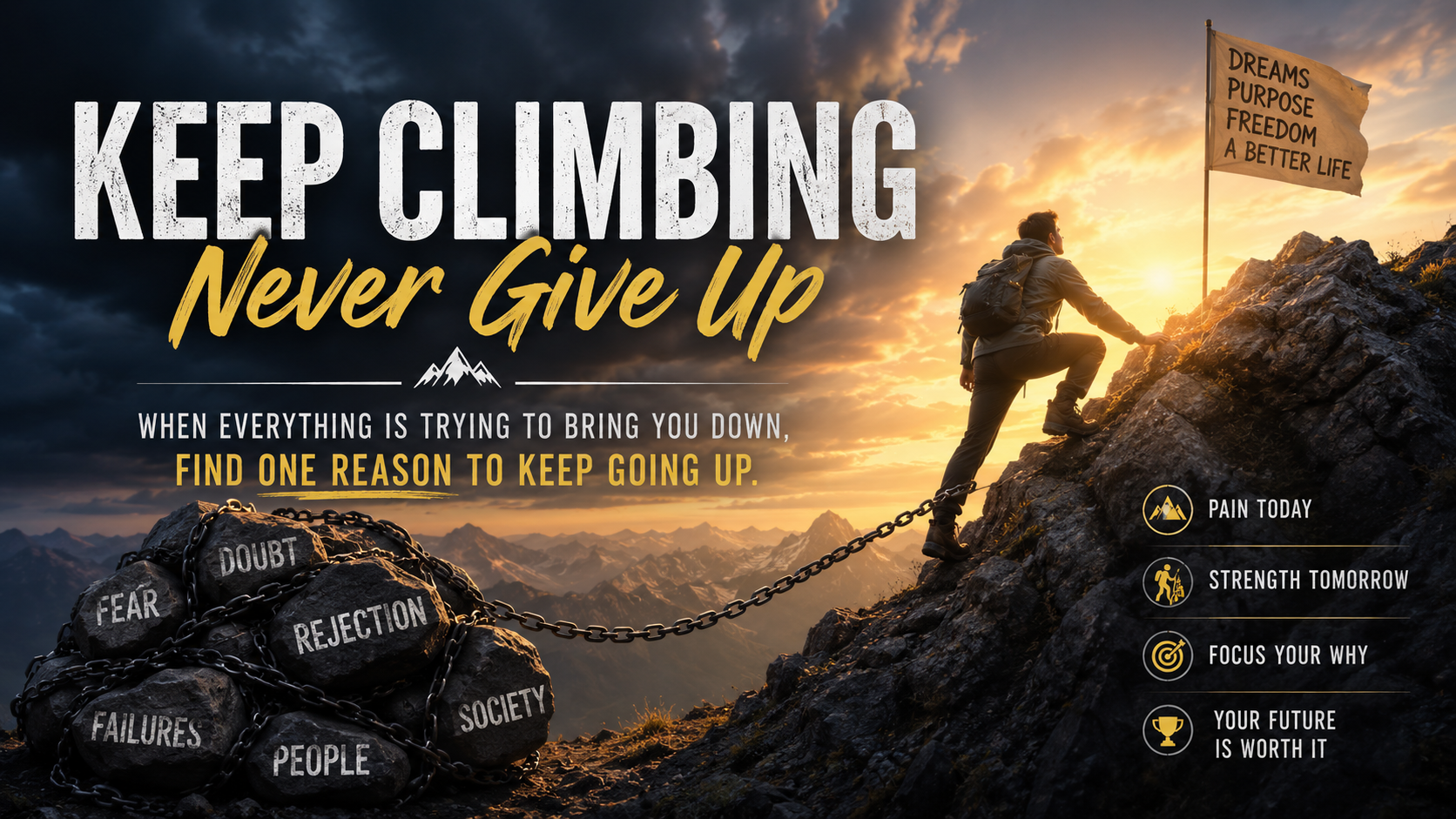
It all hangs from you like invisible stones tied around your waist while you are still somehow expected to keep climbing.
Most people know this feeling. Very few talk about it honestly.
The world loves success stories after they become successful. People celebrate the final chapter because it looks clean and inspiring. Nobody really sees the messy middle where someone is barely holding themselves together while trying not to quit.
That middle stage is where real growth happens.
Not when life becomes easy.
Not when confidence is high.
Not when everyone supports you.
Growth begins when your mind whispers, “I cannot do this anymore,” but something inside you still decides to take one more step upward.
That decision changes everything.
The Strange Reality of Human Struggle
Human beings are interesting creatures.
We can survive pain longer than we think. We can adapt to situations we once believed would destroy us. We can lose almost everything and still somehow rebuild. Yet at the same time, small emotional wounds can completely paralyze us.
One rejection email can make someone doubt ten years of talent.
One failed relationship can make someone question their worth.
One public mistake can create years of hesitation.
One bad month financially can make people feel like permanent failures.
The mind has a dangerous habit of turning temporary struggles into lifelong identities.
That is where many people stop climbing.
Not because they are incapable.
Because they become convinced the weight they carry defines who they are.
A person who failed starts calling themselves a failure.
A person who got rejected starts believing they are unworthy.
A person who struggled financially starts assuming success belongs to other people.
That mental shift is far more dangerous than the struggle itself.
Because once someone loses belief, effort starts disappearing slowly.
And life becomes smaller.
Dreams Always Cost More Than Expected
Nobody tells you how emotionally expensive dreams can become.
People love motivational quotes about ambition, but they rarely discuss the psychological tax attached to pursuing something meaningful.
Dreams demand sacrifice.
Sometimes they demand loneliness.
Sometimes they require patience far beyond what feels reasonable.
Sometimes they force you to continue working while nobody notices your effort.
There are moments where you will question whether all the struggle is even worth it.
And honestly, that questioning is normal.
Every person building something meaningful eventually reaches a stage where results arrive slower than effort.
That stage is brutal.
Because the human brain wants evidence.
It wants proof.
It wants rewards.
When effort continues without visible outcomes, motivation begins collapsing.
This is why many people quit right before progress becomes visible.
Not because they lacked talent.
Because emotionally they became exhausted carrying invisible weight without immediate results.
The hard truth is that dreams are rarely destroyed by lack of capability.
Most dreams die from accumulated emotional fatigue.
The Weight of Other People’s Opinions
Society has an interesting way of reacting to ambition.
At first, people may encourage you casually because your goals sound entertaining.
But the moment you become serious, reactions change.
Suddenly people start projecting their fears onto your future.
“You should be realistic.”
“What if it doesn’t work?”
“Maybe this is too risky.”
“People like us don’t usually do things like that.”
“Why leave something stable?”
“Are you sure you’re good enough?”
What sounds like concern often becomes disguised limitation.
Many people unknowingly speak from their own disappointments.
Someone who gave up early struggles to understand persistence.
Someone who stopped dreaming feels uncomfortable around people still trying.
Someone who accepted average life conditions may secretly resent ambition because it reminds them of the risks they avoided.
This does not make them evil.
It makes them human.
But if you absorb every outside opinion, your life slowly becomes controlled by people who are not living your future.
That is dangerous.
Because eventually you stop making decisions based on your own vision.
You start making them based on fear of judgment.
And that fear becomes another stone tied to your waist.
Why Failure Feels Personal
Failure hurts more when identity becomes attached to outcomes.
A failed project feels like proof of incompetence.
A rejected application feels like proof of inadequacy.
A business setback feels like proof you are not built for success.
But failure is rarely personal.
It is informational.
It reveals gaps.
Timing issues.
Weak strategies.
Insufficient preparation.
Wrong environments.
Lack of consistency.
Or sometimes simply bad luck.
The problem is that emotionally we process failure as character judgment instead of feedback.
That emotional interpretation creates paralysis.
People stop trying because they want to avoid feeling humiliated again.
This is why resilience matters more than raw intelligence in most long-term success stories.
The people who keep climbing are not always the smartest.
Often they are simply the ones who emotionally survived disappointment without allowing it to define them permanently.
Motivation Is Not Reliable
One of the biggest myths people believe is that successful individuals stay constantly motivated.
They do not.
Most disciplined people continue moving despite low motivation.
That difference matters.
Motivation is emotional weather.
Some days it appears naturally.
Some days it disappears completely.
If progress depends entirely on feeling inspired, consistency becomes impossible.
Real growth often happens during emotionally unremarkable days.
Days where nothing exciting happens.
Days where progress feels invisible.
Days where effort feels repetitive.
The ability to continue during ordinary difficult moments separates temporary excitement from long-term transformation.
That is why discipline eventually becomes more valuable than emotional intensity.
Because emotions fluctuate.
Systems survive.
The Quiet Damage of Constant Doubt
Doubt is dangerous because it rarely arrives dramatically.
It enters slowly.
Softly.
Repeatedly.
It convinces people to delay opportunities.
To avoid risks.
To overprepare endlessly.
To stay hidden.
To wait for perfect timing.
Many intelligent people remain stuck for years not because they lack ability, but because doubt convinces them they are not ready yet.
Perfectionism often hides fear.
Overthinking often hides insecurity.
Procrastination often hides emotional avoidance.
The mind becomes skilled at creating logical excuses to avoid uncomfortable growth.
Meanwhile life keeps moving.
And eventually people look back wondering why they never started earlier.
The tragedy is that confidence usually arrives after action, not before it.
Most people wait for confidence first.
That is why they remain stuck.
Strength Does Not Always Look Strong
Popular culture often presents strength incorrectly.
People imagine strength as confidence, certainty, and emotional control.
Real strength often looks much less glamorous.
Sometimes strength is simply continuing while exhausted.
Sometimes it is trying again after embarrassment.
Sometimes it is getting out of bed during emotionally heavy seasons.
Sometimes it is rebuilding life quietly without announcing it to the world.
Sometimes it is admitting fear but refusing to surrender to it.
Human resilience is rarely loud.
Most life-changing growth happens privately.
Away from applause.
Away from validation.
Away from attention.
People see the successful version later and assume the climb was smooth.
They never see the nights filled with self-doubt, anxiety, uncertainty, and emotional exhaustion.
But those hidden moments shape character more than visible victories ever could.
Why One Reason Is Enough
There are moments in life where you do not need complete clarity.
You do not need perfect plans.
You do not need universal support.
You do not even need full confidence.
Sometimes you only need one meaningful reason to continue.
One person who believes in you.
One future you still hope for.
One unfinished dream.
One promise to yourself.
One tiny possibility that life could improve.
That single reason can become emotionally powerful enough to keep you moving through difficult seasons.
People often survive impossible periods not because everything looked hopeful, but because something small still mattered enough.
Hope does not always arrive as fireworks.
Sometimes it arrives as stubborn refusal to give up.
The Difference Between Falling and Staying Down
Everyone falls.
Everyone struggles.
Everyone experiences moments where life feels unfair, confusing, or emotionally overwhelming.
The real difference appears afterward.
Some people interpret struggle as proof to stop.
Others interpret struggle as part of the climb.
That mindset changes outcomes dramatically.
Because pain by itself does not destroy most people permanently.
Hopelessness does.
When individuals stop believing improvement is possible, effort disappears.
Without effort, life contracts.
Opportunities shrink.
Confidence weakens further.
And slowly people begin living below their actual potential.
But when someone continues climbing despite fear, rejection, doubt, or failure, something important begins changing internally.
They build evidence.
Evidence that they can survive difficulty.
Evidence that setbacks are temporary.
Evidence that emotional pain does not automatically mean defeat.
That internal evidence becomes psychological strength.
And over time, psychological strength changes lives.
Your Climb Will Never Look Perfect
There is something important many people need to hear.
Your growth journey does not need to look impressive to others while it is happening.
Messy progress still counts.
Slow progress still counts.
Small wins still matter.
You do not need to become extraordinary overnight.
You simply need to avoid permanently stopping.
Because life changes gradually before it changes dramatically.
A person exercising consistently may not notice transformation immediately.
Someone rebuilding financially may not see visible improvement for months.
A person healing emotionally may still feel broken while actually improving internally.
Growth is often invisible before it becomes undeniable.
That is why patience matters so much.
Not passive waiting.
Active patience.
Continuing effort while results are still forming underneath the surface.
The Real Meaning of Rising
Rising is not about becoming fearless.
It is about moving despite fear.
It is not about avoiding rejection.
It is about refusing to let rejection decide your future.
It is not about living without doubt.
It is about not allowing doubt to control your direction.
Life will always attach weights to people trying to climb higher.
That part never completely disappears.
New levels bring new pressures.
New responsibilities.
New fears.
New expectations.
But people become stronger carrying them.
Not because the weight becomes lighter.
Because they become more capable.
And eventually the same struggles that once felt unbearable become stories of survival, wisdom, and resilience.
That is the strange beauty of human growth.
The climb that once nearly broke you eventually becomes proof that you were stronger than you realized.
And sometimes, during the darkest periods of life, one reason to keep climbing is enough to change the entire future.