





Money is often treated like one big subject, but in real life it is not one skill at all. It is a combination of three different skills that work together. You need to know how to make money, how to keep money, and how to grow money. Most people focus on only one of these areas and then wonder why their financial life still feels stressful, unstable, or confusing.
Some people are very good at earning. They have strong careers, good salaries, business ideas, side income, or technical skills that bring money in. Yet their bank balance does not reflect their income because every pay rise quietly turns into a bigger lifestyle, a better phone, a nicer car, more subscriptions, and a few “I deserve this” purchases that somehow become monthly habits.
Some people are excellent savers. They avoid waste, control expenses, and keep money aside. That is a strong foundation, but saving alone has limits. If money only sits in a normal account for years while prices keep rising, its real value can slowly reduce. Saving protects money, but it does not always multiply it.
Then there are people who jump straight into investing without first building earning power or financial discipline. They chase stocks, crypto, property, trading tips, or whatever is trending that month. Sometimes they get lucky for a while, but without patience, risk management, and emotional control, investing can become just another expensive hobby wearing a finance costume.
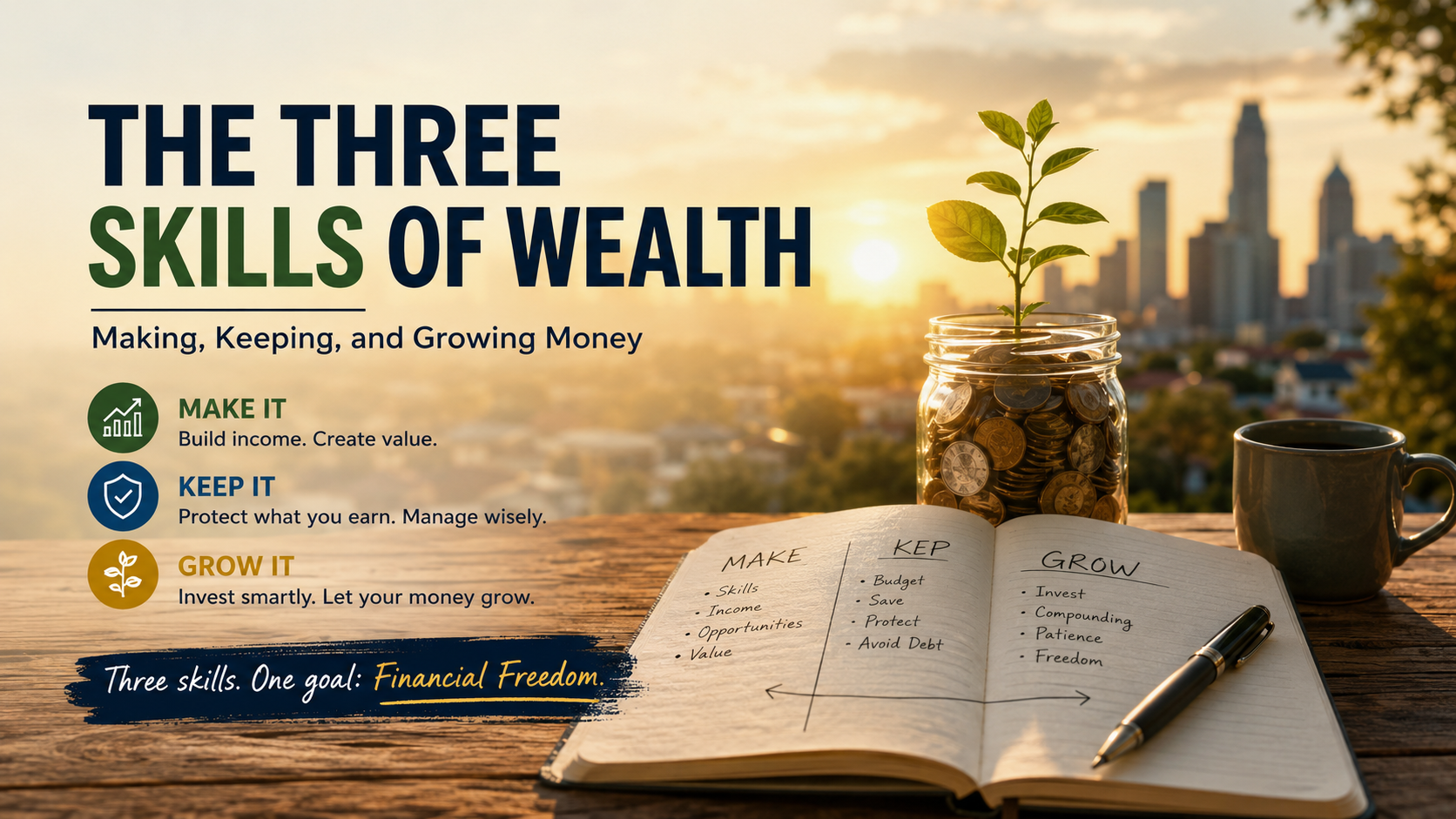
True wealth needs all three skills. You must create income, protect that income, and then put it to work over time. When these three skills come together, money stops feeling like a random visitor and starts becoming a system.
Making Money Is a Learnable Skill
The first skill of wealth is making money, and the good news is that earning more is not reserved only for people with rich parents, fancy degrees, or perfect timing. Those things may help, but they are not the whole story. In most cases, money follows value. The more useful your skills are, the more problems you can solve, and the more people or businesses are willing to pay for your work.
This is where many people misunderstand income. They think earning more is only about working harder. Hard work matters, but hard work without direction can become a treadmill. You run all day, sweat a lot, feel exhausted, and still remain in the same place financially. The real question is not only “How hard am I working?” but also “What value am I creating, and who is willing to pay for it?”
A person who develops rare and useful skills increases their earning potential. It could be coding, sales, writing, design, consulting, teaching, project management, data analysis, leadership, marketing, content creation, or building a business. The specific skill matters less than the value it creates. If your skill saves time, reduces cost, increases revenue, removes stress, improves results, or solves a painful problem, it has earning power.
Making money also requires awareness of opportunity. Two people can have the same skill, but one earns far more because they understand positioning. One waits for someone to notice them, while the other learns how to communicate value, negotiate better, build networks, improve visibility, and move towards higher-value problems. This is not luck. This is strategy.
The modern world rewards people who keep improving. A degree may open a door, but skills keep you inside the room. Industries change, tools change, markets change, and customer expectations change. People who keep learning remain valuable because they can adapt. People who stop learning often find that their income stops growing even though their expenses continue to behave like overexcited children in a sweet shop.
Making money is not just about salary either. It can include freelance work, consulting, digital products, business ownership, rental income, royalties, content income, or small side projects that grow slowly. The aim is not to become busy in ten different directions. The aim is to build income streams around your strengths, time, risk appetite, and life stage.
Income Alone Does Not Create Wealth
A high income can be powerful, but it is not the same as wealth. Income is what comes in. Wealth is what stays and grows. This difference sounds simple, yet it is the reason many high earners still feel financially trapped.
A person can earn a large salary and still live month to month. This happens when expenses rise at the same speed as income. The moment more money arrives, the lifestyle upgrades begin. A bigger house, a better car, more eating out, premium brands, expensive holidays, new gadgets, and a few harmless-looking monthly payments. Individually, these decisions may feel manageable. Together, they create financial pressure.
This is lifestyle inflation, and it is one of the most common reasons people fail to build wealth. The danger is that it does not feel dangerous at first. It feels like progress. You tell yourself that you worked hard and deserve comfort. That may be true, but comfort without boundaries becomes a financial leak.
Income gives you options, but discipline decides whether those options create freedom or stress. Without money management, earning more can simply make your mistakes bigger. A person earning £3,000 a month and spending £3,200 has a problem. A person earning £10,000 a month and spending £11,000 has the same problem, just wearing a more expensive watch.
Wealth begins when there is a gap between what you earn and what you spend. That gap is where savings, investments, emergency funds, and future freedom are born. Without that gap, there is no wealth building. There is only movement.
Keeping Money Requires Discipline
Keeping money is less glamorous than making money, but it is just as important. Nobody claps when you do not buy something unnecessary. Nobody gives you an award for ignoring an impulse purchase. There is no social media post that says, “Today I did not buy things I do not need, and my future self is proud.” Yet these boring decisions are often what create financial stability.
Keeping money is mainly about behaviour. Budgeting matters, but the real work is emotional. People do not overspend only because they cannot calculate. Many overspend because spending gives comfort, status, distraction, validation, or a temporary sense of control. Money decisions are often emotional decisions pretending to be logical ones.
This is why discipline is so powerful. Discipline does not mean living like a monk, never enjoying life, or treating every coffee like a financial crime. It means deciding what matters before emotions take over. It means knowing your priorities clearly enough that every sale, trend, and shiny offer does not control you.
A good money system makes discipline easier. You should know your fixed costs, variable costs, debts, savings goals, and investment contributions. You should know how much money is safe to spend without damaging your future plans. When you do not have a system, every purchase becomes a debate. When you do have a system, decisions become lighter because the rules are already set.
Emergency savings are also part of keeping money. Life is not always polite enough to ask permission before creating problems. Cars break down, jobs change, health issues appear, family needs arise, and unexpected bills land with the confidence of an unwanted guest. An emergency fund does not stop problems, but it prevents every problem from becoming a financial crisis.
Spending Control Is More Important Than Salary
A moderate income with strong spending habits can create more wealth than a high income with poor spending habits. This is not a motivational quote. It is basic mathematics with a little human psychology sprinkled on top.
If someone earns £4,000 a month and saves £800 consistently, they are building financial strength. If someone earns £9,000 a month and saves nothing because their lifestyle consumes everything, their income looks impressive but their financial position is weak. The outside world may admire the second person more, but the first person may sleep better.
Spending control does not mean being cheap. Cheapness is often about fear. Good spending control is about intention. You can spend generously on things that matter to you while cutting ruthlessly on things that do not. The goal is not to remove joy from life. The goal is to stop wasting money on things that bring very little lasting value.
One useful question is, “Will this purchase still matter to me after one week, one month, or one year?” Some purchases genuinely improve life. Others only create a short burst of excitement followed by storage problems and mild regret. The more you understand this difference, the better your money decisions become.
Debt also plays a major role here. Some debt can support long-term growth, such as a sensible mortgage, education investment, or business funding used carefully. But consumer debt can quietly destroy progress. Credit cards, buy-now-pay-later schemes, and personal loans can make spending feel painless today while adding pressure tomorrow. Debt turns future income into payment obligations before you even receive it.
Growing Money Requires Time and Patience
Once you can earn money and keep some of it, the next skill is growing it. This is where patience becomes important. Many people want wealth to grow quickly, but real compounding prefers time over drama.
Growing money means putting it into assets that have the potential to increase in value, generate income, or both. This may include investments, pensions, index funds, property, businesses, or other productive assets. The right route depends on your goals, risk tolerance, knowledge, and personal circumstances.
The key idea is that money should not remain idle forever. Savings are important for short-term needs and emergencies, but long-term wealth usually requires growth. Inflation slowly increases the cost of living, so money that does not grow can lose purchasing power over time. That is why investing becomes necessary for many people who want long-term financial freedom.
However, investing is not magic. It is not a shortcut for people who are bored with normal progress. It requires knowledge, patience, emotional control, and a clear strategy. If you invest without understanding risk, you may panic when markets fall. If you chase quick gains, you may enter at the wrong time and exit at an even worse time. If you follow every online tip, your portfolio may end up looking like a confused group project.
Good investing is often less exciting than people expect. It usually involves consistency, diversification, time in the market, and avoiding emotional decisions. The best investors are not always the loudest people online. Often, they are the ones who follow a sensible plan for many years while everyone else is busy reacting to headlines.
Investing Is a Separate Skill from Earning
Being good at earning money does not automatically make someone good at investing. These are different skills. Earning money often rewards action, confidence, ambition, and problem-solving. Investing often rewards patience, restraint, humility, and the ability to sit through uncertainty without doing something foolish.
A successful professional may be brilliant in their career but still make poor investment decisions because they are not used to feeling out of control. Markets do not care about your job title. They do not become gentle because your LinkedIn profile looks impressive. They rise, fall, confuse people, and test emotions.
This is why emotional control matters so much. Fear and greed are two of the most expensive emotions in finance. Greed makes people buy into hype when prices are high. Fear makes people sell in panic when prices are low. Both emotions create poor timing.
A good investor understands that risk cannot be removed completely, but it can be managed. Diversification, asset allocation, long-term thinking, and regular contributions can reduce emotional pressure. The aim is not to predict every market movement. The aim is to build a strategy that can survive uncertainty.
Wealth Is Built in Stages
Most people should build wealth in stages. Trying to do everything at once can create confusion. The first stage is increasing earning ability. Without income, there is very little to manage or invest. This stage is about skills, career growth, business ideas, better opportunities, and value creation.
The second stage is keeping money. This means building savings, controlling spending, reducing harmful debt, and creating financial breathing space. This stage may feel boring, but it is the foundation. Without it, higher income often disappears.
The third stage is growing money. Once you have income and stability, you can focus more seriously on long-term investments and scalable income sources. This is where compounding starts to do meaningful work.
These stages can overlap, but the order matters. If you try to grow money before learning to keep it, you may invest while still carrying expensive debt or having no emergency fund. If you focus only on saving without improving income, progress may feel painfully slow. If you only increase income but never control spending, wealth remains out of reach.
Financial Freedom Is Created by Systems
Financial freedom is rarely created by one big decision. It is usually created by repeated decisions that become systems. Automatic savings, regular investments, controlled spending, debt repayment plans, income reviews, and simple financial tracking can produce powerful results over time.
Systems matter because motivation comes and goes. Some months you feel inspired. Some months life gets messy. A system keeps working even when your mood changes. When savings leave your account automatically, you do not need to argue with yourself every month. When investments are scheduled, you do not need to wait for perfect timing. When spending limits are clear, you do not need to make every decision from scratch.
A strong money system should be simple enough to follow. Complicated systems often fail because they depend on too much willpower. You do not need fifty spreadsheets and a finance degree to manage money well. You need clarity, consistency, and honest behaviour.
The Real Meaning of Wealth
Wealth is not only about having more money. It is about having more choice. It means being able to handle emergencies without panic. It means being able to leave toxic situations more easily. It means having time for family, health, learning, travel, creativity, service, or whatever matters most to you.
Money is not the purpose of life, but lack of money can make life unnecessarily difficult. Financial strength gives you room to breathe. It gives you options. It reduces the number of decisions controlled by fear.
The three skills of wealth are simple to understand, but they require practice. Make money by becoming valuable. Keep money by controlling behaviour. Grow money by using patience, strategy, and time. When these three skills work together, wealth becomes less mysterious and more practical.
The goal is not to become obsessed with money. The goal is to build a life where money supports your peace, choices, and future instead of constantly demanding your attention. That is real wealth, and it begins with learning the skills that make money work for you rather than against you.