





The past deserves to be understood, but it cannot be allowed to make every decision about what comes next
On the morning he was offered the promotion, Daniel called his older brother before he told anyone else. He had spent six years working toward a role that would let him lead a small design team, yet the first words out of his mouth were not about the salary, the people, or the work. He wanted to know whether his brother thought he was ready.
His brother congratulated him, then asked a sensible question: “What do you think?”
Daniel looked at the email on his laptop and found that he could describe every possible way the job might go wrong. He could imagine a difficult first meeting, a missed deadline, an employee who knew more than he did, and the embarrassing possibility that someone would eventually realise they had made a mistake.
He could not say, without adding several qualifications, that he wanted the position.
That evening, he found the source of his hesitation in a memory he had carried for almost twenty years.
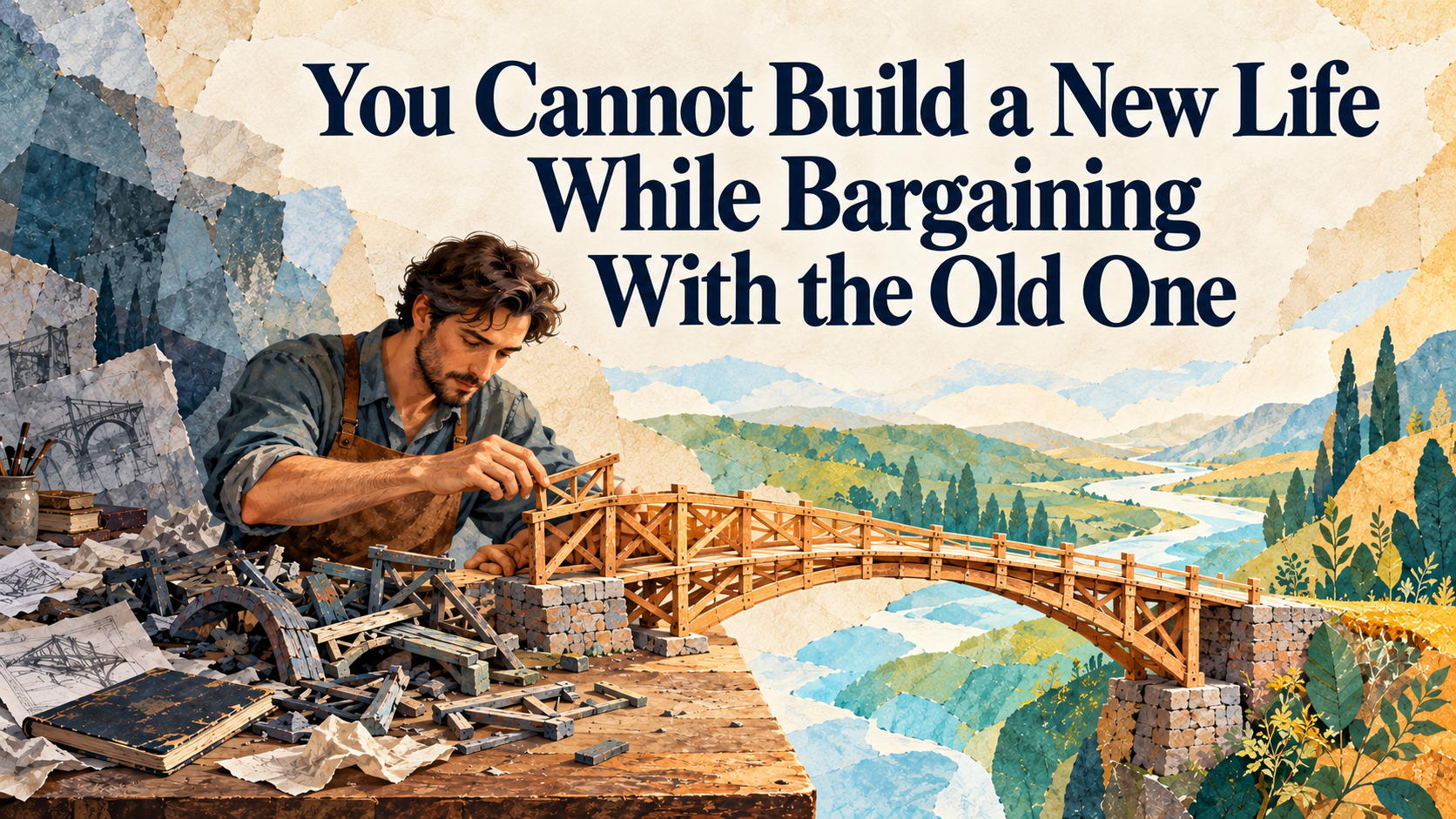
At sixteen, he had entered a regional design competition with a model bridge he had built over several weekends. A teacher praised his ambition but pointed out a flaw in its construction in front of the class. The bridge had held during the demonstration, although Daniel remembered only the laughter that followed the teacher’s comment.
Whenever someone asked him to take a visible risk, he found himself standing beside that desk again, waiting to be exposed.
The teacher had long since retired, his classmates had moved into lives of their own, and the bridge was probably in a landfill somewhere. Daniel, however, was still allowing that afternoon to negotiate the terms of his future.
How the Past Gets a Vote
Most people do not make a conscious agreement to live according to an old disappointment. The arrangement develops gradually, through small decisions that appear reasonable when viewed one at a time.
You avoid speaking up because the last time you did, someone dismissed you.
You keep emotional distance because a person you trusted once left.
You postpone applying for a better job because an earlier rejection seemed to confirm something painful about your abilities.
These choices can feel like wisdom because they offer protection from a hurt you already know. The difficulty is that protection can become a permanent condition, even after the circumstances that called for it have disappeared.
A person who was betrayed may begin treating every new relationship as a trial in which the other person must prove they are different.
Someone who grew up hearing that money was always about to run out may struggle to enjoy a stable income.
A professional who made one public mistake may spend years doing excellent work while declining any opportunity that would place them in view.
The past is useful when it gives us information. It becomes restrictive when an old event is promoted into a rule that governs situations it has never encountered.
Daniel’s embarrassment had taught him that public criticism could sting, which was true. Over time, he had added a larger conclusion: if he became more visible, embarrassment was inevitable and would be impossible to bear. That conclusion was never tested fairly.
Each time an opportunity arrived, he withdrew early enough to avoid discovering what might have happened.
The Bargains We Make Without Realising
Negotiating with your past often sounds like a promise to yourself. You can pursue what you want once you feel completely confident. You can trust someone when you have certainty they will never disappoint you. You can change careers after you have found a way to guarantee that the first attempt will succeed.
Each bargain postpones movement until the risk of being hurt has disappeared.
The terms sound responsible, but life rarely offers that kind of guarantee. Confidence often follows action, trust develops through experience, and a new direction reveals its possibilities only after you have begun walking toward it. If certainty is the price of admission, the door stays closed.
There are more personal bargains as well. Some people believe they must first make their parents proud of the path they have already taken before choosing one that fits. Others wait for an apology from someone who injured them, hoping that a few words will finally grant permission to live differently.
An apology may matter deeply, and accountability matters too, but another person’s willingness to recognise the damage should not determine whether the rest of your life can begin.
When Daniel considered declining the promotion, he told himself he was being realistic. His brother listened and asked him to describe the actual demands of the role.
Daniel knew the work, had already mentored two junior colleagues, and had earned the trust of the manager who recommended him. The concerns he could name were practical and manageable. The dread attached to them came from somewhere else.
Understanding Is Different From Obeying
Moving forward does not require you to pretend that what happened did not matter. Some experiences change a person in lasting ways, and it can take time, support, and considerable care to understand their effects. Grief cannot be placed on a schedule. Betrayal may call for stronger boundaries.
A childhood shaped by criticism may leave habits that do not disappear simply because an adult can explain where they came from.
Understanding the past means asking what happened, what it taught you, and which of those lessons still serve you. Obeying it means treating every conclusion formed during a painful moment as though it remains true forever.
There is a difference between saying, “That experience taught me to prepare carefully,” and saying, “I must avoid every situation in which I could be criticised.” Preparation gives you a way to participate.
Avoidance makes your world smaller. One response uses memory as a resource; the other hands memory the authority to choose.
This distinction can be difficult to see because the restrictive rule often speaks in your own voice. It may sound like caution, maturity, or an accurate assessment of your limits.
A useful question is whether the rule helps you engage with the life you want, or whether it repeatedly removes you from it.
Another is whether you would give the same advice to a friend whose abilities and circumstances you knew as well as your own.
Daniel realised he would never tell one of his junior colleagues to refuse a leadership role because a teacher had criticised a school project. Hearing the story in someone else’s life made the disproportion clear. In his own life, the old feeling had made it seem logical.
The Future Is Built Through Different Decisions
Changing your relationship with the past is rarely a single dramatic breakthrough. More often, it happens through decisions so ordinary that nobody else recognises their significance.
You submit the application despite the memory of rejection.
You tell a partner what you need instead of waiting for them to guess and then resenting them for getting it wrong.
You ask for help with money, health, or grief before the situation becomes unbearable.
You allow yourself to be a beginner at something after years of being competent elsewhere.
These actions do not erase fear. They give you evidence that fear can accompany a decision without making it for you. They also leave room for the possibility that a new attempt may turn out differently from the old one, because the people, circumstances, and version of you involved are different.
Daniel accepted the promotion. During his first month, he made a poor call about a project schedule and had to explain the delay to his team. The conversation was uncomfortable, and one colleague challenged his assumptions directly. He listened, changed the plan, and went home irritated with himself.
Yet by the following morning, the team was working from a better schedule, and nobody had mistaken one error for the whole of his character.
The moment did not prove that he would never be embarrassed again. It proved that embarrassment was survivable, that other people could disagree with him without rejecting him, and that his future did not have to be arranged around avoiding a feeling he had first known at sixteen.
What You Can Carry Forward
There may be parts of your history you want to keep close: the persistence you developed during a hard period, the tenderness you learned after loss, or the clarity that came from discovering what you will no longer accept.
Moving forward does not mean discarding those things. It means choosing deliberately what you carry and recognising when an old defence has started demanding more from you than it gives back.
You can honour the person who got through a difficult chapter without requiring that person to design every chapter that follows. Their caution may have been necessary then. Their endurance may have made your present possible. They deserve gratitude, and you deserve the chance to use everything you have learned since.
If a decision in front of you feels strangely larger than the facts justify, pause long enough to ask whose voice you are hearing and when you first learned to listen to it. Then look at what is true now.
Who is involved?
What resources do you have?
What could you do if things became difficult?
The answers may still lead you to step back, and that can be a sound choice. They may also reveal that you have been asking an old injury for permission that it cannot give.
Your past will remain part of your story, including the chapters you wish had unfolded differently. It can explain why a door feels difficult to open, and it can help you prepare for what lies beyond it.
But when the choice belongs to the life you are living now, the final word should belong to you.